Explore the sections in this article
First, decide what “day” means
On Earth, several useful definitions of a day are close enough that ordinary conversation can ignore the difference. A sidereal day measures one full rotation relative to distant stars. A solar day measures the interval from one local noon to the next—or, approximately, from one sunrise to the next.
Venus makes that distinction impossible to ignore. NASA gives its rotation period as roughly 243 Earth days. Its year—the time required to complete one orbit of the Sun—is about 225 Earth days. By the rotation definition, a Venusian day really is longer than a Venusian year.
Saying “a day is longer than a year” is accurate when day means one axial rotation. It is not accurate when day means sunrise to sunrise. Both numbers are real and both are used by planetary scientists; the headline only works because the longer definition is the one being quoted. We keep that distinction visible in the article and in every caption rather than letting the shorter, punchier version stand alone.

Why sunrise arrives sooner than the rotation ends
Venus rotates in the opposite direction from most planets, a motion called retrograde rotation. At the same time, it continues moving forward along its orbit around the Sun. Those two movements combine so that the Sun returns to the same position in the Venusian sky after about 117 Earth days, well before the planet completes its 243-day rotation relative to the stars.
If you could survive on the surface, the Sun would appear to rise in the west and set in the east. Sunrise to sunset alone would take roughly 58 Earth days. The word “slow” hardly captures it: an entire human season could pass while the Sun crossed half the sky.
A day you could not comfortably watch
The slow sky is not the only problem. Venus is wrapped in a massive atmosphere made mostly of carbon dioxide, with clouds of sulfuric acid. Its runaway greenhouse effect raises the average surface temperature to roughly 464–467°C, and surface pressure is about 93 times Earth’s sea-level pressure.
The thick clouds hide the ground from ordinary visible-light cameras. Spacecraft such as NASA’s Magellan mapped the surface with radar, revealing volcanic plains, mountains and heavily deformed terrain beneath the bright cloud deck.
How scientists measured such a slow spin
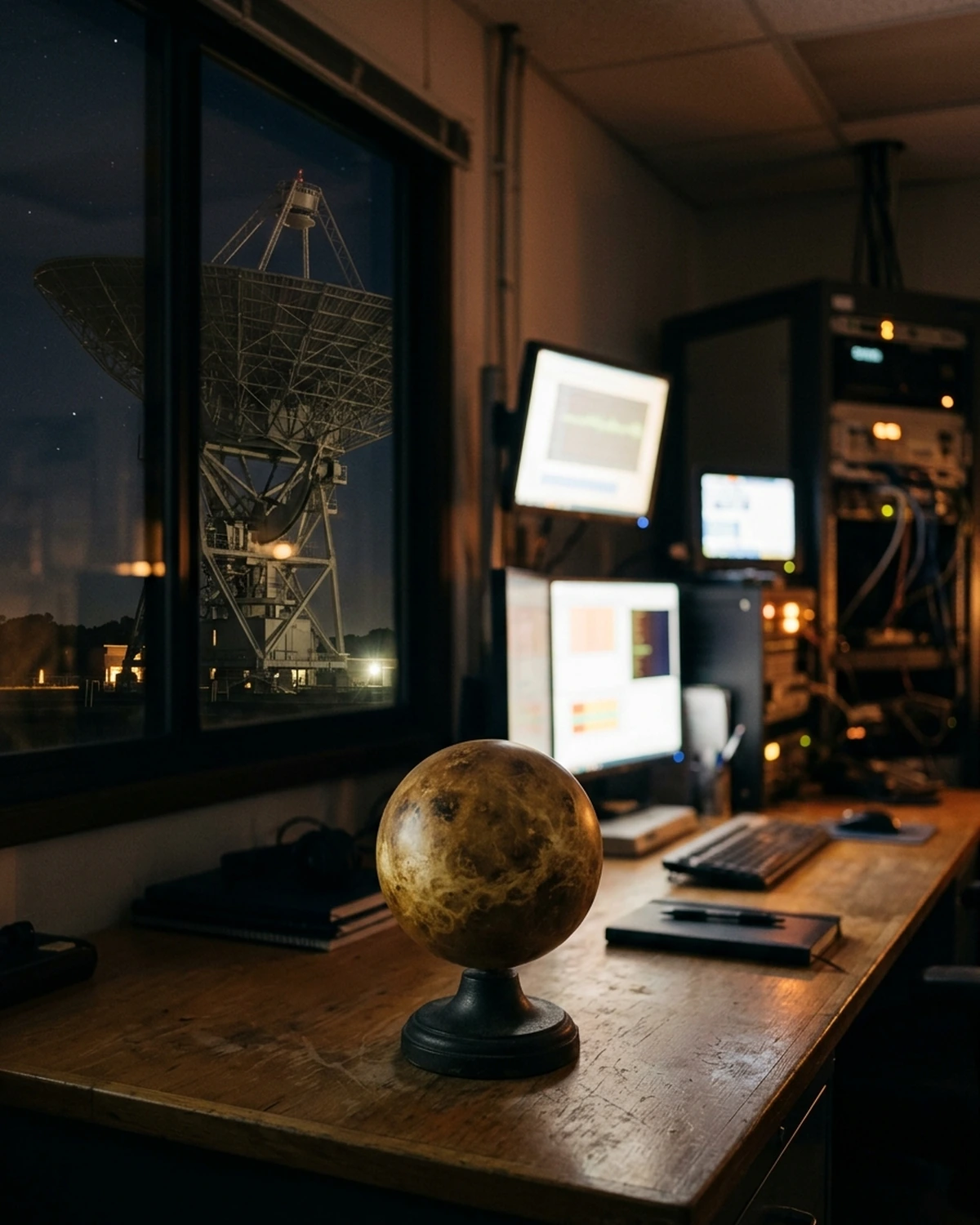
Venus turns so slowly that astronomers can track surface features with radar over long periods. Modern Earth-based radar measurements also reveal that its rotation rate varies slightly. A published analysis of observations from 2006 through 2020 reported an average sidereal day of about 243.0226 Earth days.
That precision does not weaken the simple story; it improves it. The memorable headline opens the door, while the full article shows readers what was measured, which definition is being used, and where the remaining complexity lives.
Why Venus turns the wrong way
Almost everything in the solar system spins the same way, and for a good reason: the planets condensed out of one rotating disc of gas and dust, and they inherited its direction of travel. Venus did not. Its north pole is tipped over by roughly 177 degrees, which is another way of saying the planet is very nearly upside down. Seen from above the solar system's shared plane, Venus turns clockwise while Earth, Mars and Jupiter all turn anticlockwise.
There are two families of explanation, and they are not mutually exclusive. The first is a collision: a large enough impact early in the planet's history could have knocked it over or reversed its spin outright. The second is subtler and, on current evidence, more likely to have done most of the work. Venus carries an enormously heavy atmosphere, and the Sun heats it unevenly. That heating raises atmospheric tides — slow bulges of dense air — which the Sun's gravity then tugs on. Over billions of years those tides can act as a brake and a lever at the same time.
In 2001 Alexandre Correia and Jacques Laskar modelled the problem and found that friction between Venus's core and mantle, combined with those atmospheric tides, funnels the planet toward a small number of stable end states. Two of the four involve retrograde rotation, and Venus could have reached its present condition without ever being hit by anything at all. The uncomfortable honest answer is that we do not know which story is right, only that both are physically possible and that the atmosphere is doing more of the work than anyone expected before the calculation was done.
Key fact
Venus's axial tilt is about 177 degrees. A planet tipped almost exactly upside down is indistinguishable, from the outside, from a planet spinning backwards — which is why both descriptions are used.
The spin is not quite steady
A planet's rotation period sounds like the kind of number that should be fixed to as many decimal places as you care to measure. Venus is not that cooperative. Radar measurements taken over decades do not all agree, and the disagreements are larger than the measurement errors. Magellan's early-1990s data implied a sidereal day of about 243.02 Earth days; some later Earth-based radar runs came out several minutes different.
The most likely culprit is again the atmosphere. Venus's upper air super-rotates — the cloud deck circles the planet in roughly four Earth days, some sixty times faster than the solid body underneath it. ESA's Venus Express, which observed the planet from 2006 to 2014, tracked those winds getting measurably faster over the course of the mission. An atmosphere that heavy, moving that fast, exchanges angular momentum with the ground beneath it, and dragging over the planet's mountain ranges appears to nudge the rotation rate up and down by small amounts on a timescale of years.
Jean-Luc Margot and colleagues addressed the scatter directly, averaging twenty-one separate radar observations made between 2006 and 2020 into a single figure of 243.0226 Earth days, with an estimated variability of about a few minutes around that mean. That is what a measured number looks like when the thing being measured genuinely wobbles: not a failure of instrumentation, but a physical result about how tightly an atmosphere and a planet are coupled.
Key takeaways
- Venus rotates once in about 243 Earth days and orbits the Sun in about 225, so by the rotation definition a day does outlast a year.
- By the sunrise-to-sunrise definition, a Venusian day is about 117 Earth days — shorter than the year, and shorter than one rotation.
- The two figures differ because Venus moves along its orbit as it turns, and because it turns retrograde.
- Venus is tilted roughly 177 degrees; a giant impact and long-term atmospheric tides are both plausible causes, and the tides may be sufficient on their own.
- The rotation rate is not perfectly constant — the super-rotating atmosphere appears to speed it up and slow it down by minutes over years.
- The best current value, averaged over 2006–2020 radar observations, is 243.0226 Earth days.
Sources and further reading
- NASA Science: Venus Facts — rotation, orbit, retrograde motion, atmosphere, temperature and pressure.
- Margot et al.: Spin State and Moment of Inertia of Venus — modern radar measurement of Venus’s rotation.
- NASA Science: Solar System Temperatures — comparative planetary temperature context.
- Correia & Laskar (2001), The four final rotation states of Venus, Nature 411, 767–770 — core–mantle friction and atmospheric tides as a route to retrograde rotation.
- Navarro et al. (2018), Atmospheric mountain wave generation on Venus and its influence on the solid planet’s rotation rate, Nature Geoscience — how the atmosphere changes the length of a Venusian day.
- ESA — Venus Express science highlights — super-rotation of the cloud deck and the winds measured from 2006 to 2014.
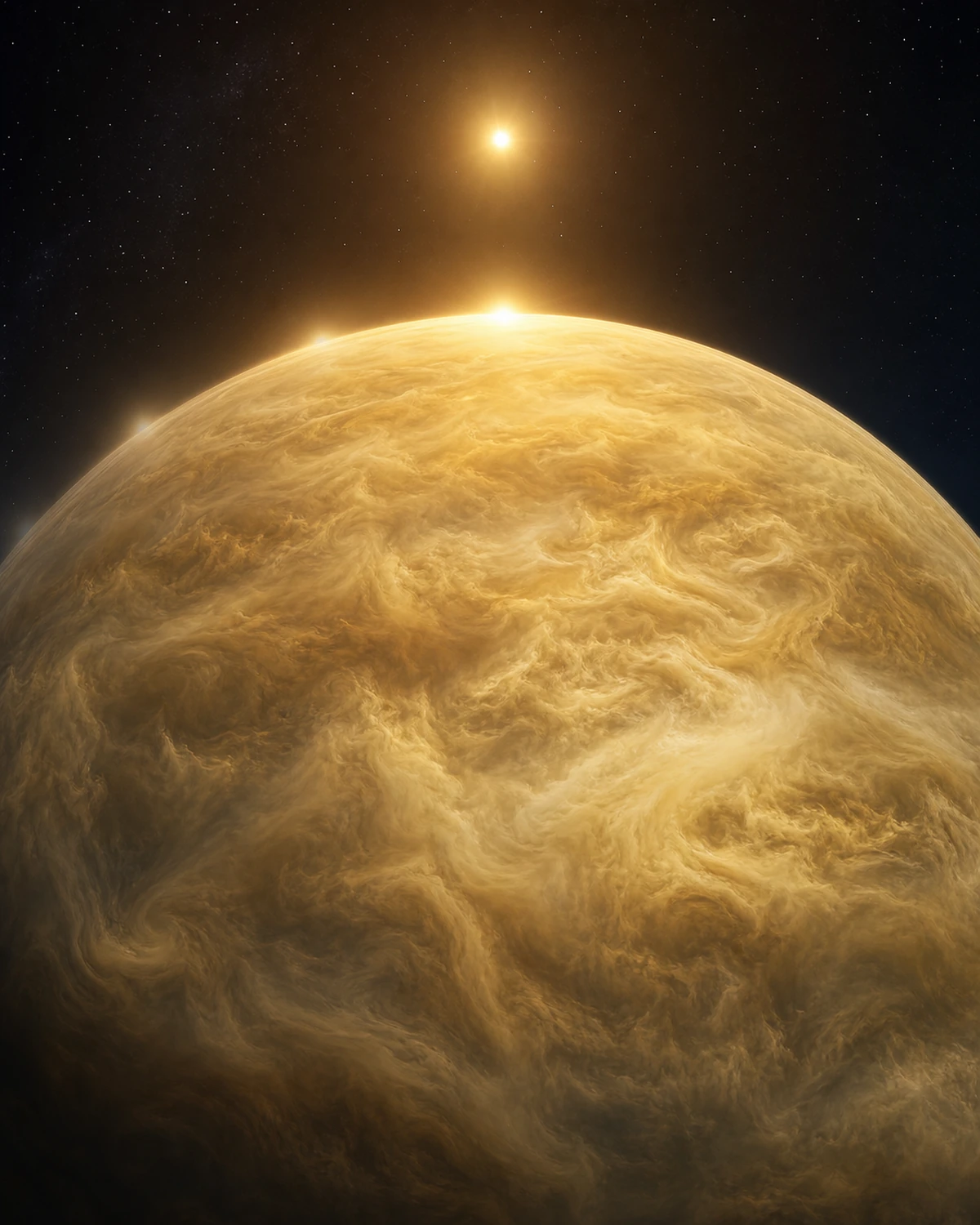
Visual note: The 4:5 Venus artwork is an original AI-assisted editorial visualization. It is not a spacecraft photograph and is not used as scientific evidence.
11 September 2026 update: added a sourced interactive model and clarified its assumptions. Editorial change log
Explore the idea
Try it: rotation is not the same as a solar day
Change the rotation period of a hypothetical retrograde planet while keeping its year at 224.7 Earth days. Watch how long it takes for the Sun to return to the same position.
Solar day = 1 ÷ (1 ÷ rotation period + 1 ÷ orbital period).
This model uses uniform retrograde rotation and a circular orbit. It calculates a full solar cycle, not daylight duration; actual apparent solar motion varies.
Model background: NASA: Venus rotation and solar day
Frequently asked questions
Is a day on Venus really longer than its year?
Yes, when ‘day’ means one complete rotation relative to the stars. Venus rotates in about 243 Earth days but orbits the Sun in about 225 Earth days.
How long is sunrise to sunrise on Venus?
A solar day on Venus—from one sunrise to the next—lasts about 117 Earth days because the planet moves along its orbit while rotating.
Which direction does the Sun rise on Venus?
Venus rotates retrograde, opposite the direction of most planets, so the Sun would appear to rise in the west and set in the east.
Why does Venus spin backwards?
Venus is tilted about 177 degrees, so it turns clockwise seen from above the solar system’s plane. A large early impact could explain it, but modelling by Correia and Laskar (2001) showed that friction inside the planet combined with solar tides in its very heavy atmosphere can produce retrograde rotation on their own. Both remain live explanations.
Is Venus’s rotation period exactly constant?
No. Radar observations disagree by more than their measurement errors, and the super-rotating atmosphere — which laps the planet roughly every four Earth days — appears to speed the surface up and slow it down by a few minutes over years. The 2021 averaged value is 243.0226 Earth days.
Continue exploring
Three questions to read next.
 Space & AstronomyWhat Would Happen If the Sun Suddenly Disappeared?Read next →
 Space & AstronomyWhat Would Happen If the Earth Stopped Spinning?Read next →
 Space & AstronomyWhy Does the Earth Spin?Read next →