Science explained · Earth & Environment
How Do Caves Form?
How does groundwater turn a fracture too narrow for a hand into a chamber large enough to hold a building?
Explore the sections in this article
The rock already contains a map of possible routes
Limestone is largely calcium carbonate, commonly in the mineral calcite. It may be massive at human scale, yet it contains discontinuities. Bedding planes separate depositional layers. Joints form as rock responds to stress without obvious sliding. Faults record displacement. Primary pores and later fractures give groundwater paths.
Water does not invent that framework, though dissolution can transform it. At first, most openings are microscopic or millimetric. Flow may be slow and spread through many paths. The eventual cave pattern depends on which paths connect recharge to discharge, the hydraulic gradient, rock purity, fracture geometry and how quickly water chemistry is renewed.
Karst is the broader landscape produced by dissolution of soluble rock, especially limestone and dolomite. It can include sinkholes, sinking streams, springs, underground drainage and caves. A cave is therefore one part of a groundwater system, not an isolated hollow sealed from the surface.
Soil lends rainwater chemical leverage
Pure water can dissolve some calcite, but natural water usually arrives with dissolved carbon dioxide. Rain takes up CO₂ from the atmosphere; percolating water can acquire much more from root respiration and microbial decay in soil. Carbon dioxide reacts reversibly with water, often summarized as:
CO₂ + H₂O ⇌ H₂CO₃
Carbonic acid is weak, and much dissolved CO₂ is not present as discrete H₂CO₃ molecules. The shorthand is still useful because the carbonate system supplies hydrogen ions and bicarbonate. A common net expression for limestone dissolution is:
CaCO₃ + CO₂ + H₂O ⇌ Ca²⁺ + 2HCO₃⁻
The products can travel in water. “Acid eats rock” misses the equilibrium: temperature, CO₂ pressure, mixing, mineral saturation and flow control whether calcite dissolves or precipitates. The reversible arrow will become important when the same water enters cave air.
A breakthrough is hydraulic, not explosive
In a narrow fracture, dissolution may be strongest near the water’s entry because chemical capacity is used up along the path. That seems to limit how a long cave could ever form. Coupled flow-and-reaction research shows why the limitation can break: slow early enlargement eventually permits faster flow, so less-equilibrated water penetrates farther. Once a path reaches this “breakthrough,” conduit growth can accelerate geologically.
Neighboring routes compete. A slightly more open path offers less hydraulic resistance and captures discharge. Branchwork caves can emerge where recharge is concentrated; maze patterns can form when water is supplied across many alternative routes or under different hydraulic conditions. Rock structure guides the geometry but does not dictate it alone.
The word “cave formation” thus covers at least three time scales: the slow creation of initial pathways, faster conduit enlargement after breakthrough, and later collapse, sediment filling or mineral decoration. A polished tourist chamber is not a frozen snapshot of one process.
Many passages grow while full of water
The familiar picture shows an underground stream cutting down through an open tunnel. Yet major solutional enlargement often occurs in the saturated zone, where openings are water-filled, or near a changing water table. Water can move under pressure through rising and descending loops; “underground river” is not always a free-surface channel.
As valleys deepen or regional drainage changes, the water table may fall. Former conduits drain and become air-filled. Streams can incise lower levels, leaving abandoned upper passages. Mammoth Cave’s stacked levels record changing surface rivers and regional erosion over millions of years.
Once a passage is air-filled, gravity does more visible sculpting. Roof blocks detach along fractures. Sediment enters, moves or armors the floor. Floods can temporarily refill passages. The present dry route may be a fossil of an older groundwater level, while active dissolution continues unseen below.
The decorations usually arrive after the room
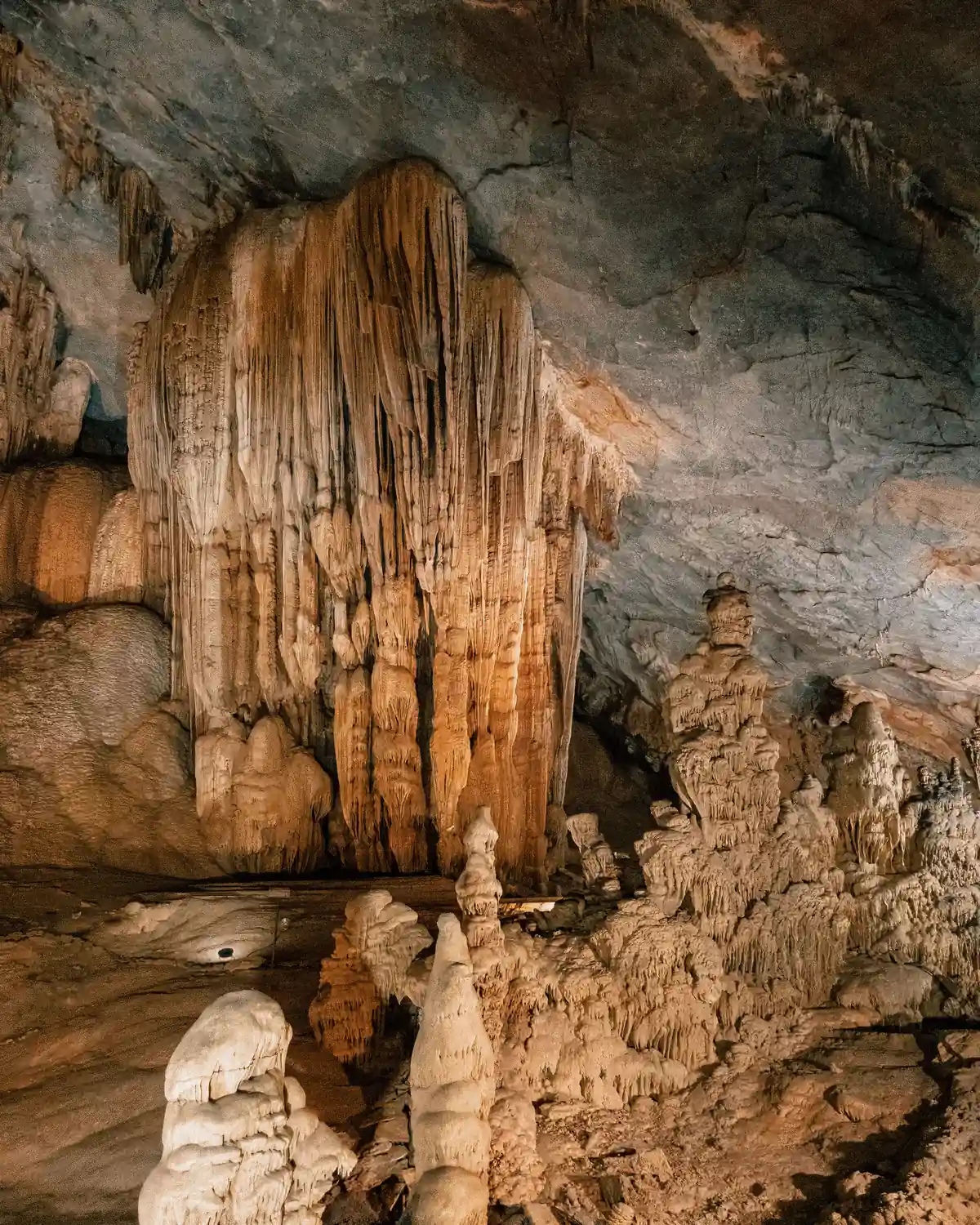
Stalactites and stalagmites are speleothems: secondary mineral deposits in caves. They should not be drawn as teeth that dissolved the chamber. In many limestone systems, the large void formed first under saturated conditions. Decoration became possible after the passage contained air.
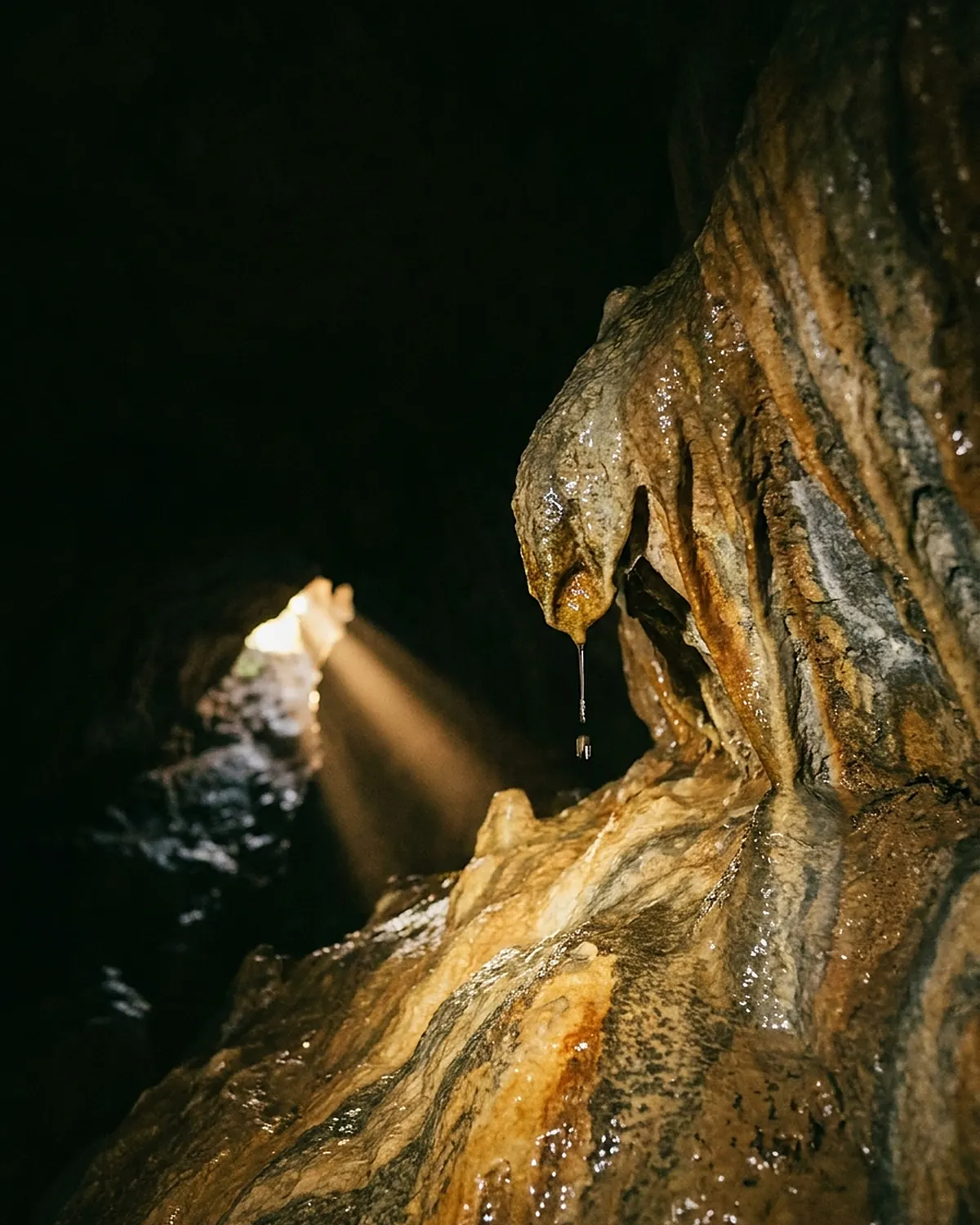
Water descending from soil and limestone can carry calcium and bicarbonate. On entering cave air, it may lose carbon dioxide. That shifts the carbonate equilibrium toward calcite precipitation. A ceiling droplet can leave a ring and extend a hollow “soda straw.” Continued deposition may thicken it into a stalactite. The falling drop can deposit more calcite on the floor, building a stalagmite. Flowstone records sheets rather than individual drips.
Growth is not a universal clock. Drip rate, chemistry, temperature, ventilation, impurities and changes above ground all matter. A centimeter cannot be assigned a standard number of years. Uranium-thorium dating and layer chemistry can make some speleothems valuable climate archives, but interpretation requires screening for open-system behavior, hiatuses and local hydrology.
A chamber-sized calculation: how much rock is absent?
Imagine an idealized passage 100 metres long, averaging 20 metres wide and 10 metres high. Treating it as a rectangular box gives:
100 m × 20 m × 10 m = 20,000 m³
Using a calcite density near 2,710 kg/m³, the equivalent solid mass is:
20,000 m³ × 2,710 kg/m³ = 54,200,000 kg
That is about 54,000 metric tonnes of calcite-equivalent rock. It was not necessarily carried out in one stream or dissolved uniformly. Real chambers are irregular; some volume comes from mechanical collapse; limestone contains impurities and pores; dissolved load can reprecipitate elsewhere. The estimate does one job: it shows why an immense-looking void can result from ordinary water acting through a sustained, connected transport system.
Never use this box calculation to date a cave. Without a history of discharge, saturation, geometry and collapse, volume divided by a guessed dissolution rate produces false precision.
Carlsbad rewrites the carbonic-acid script
Carlsbad Cavern is famous precisely because its major chambers require a different acid source. NPS describes hydrogen-sulfide-rich water moving through fractures and mixing with oxygen-bearing groundwater. Oxidation produced sulfuric acid, which dissolved the Capitan limestone and left gypsum, clay and silt as evidence.
The aggressive water came from below or laterally rather than simply descending from soil. This “hypogenic” history helps explain chamber shapes and mineral residues that a standard surface-recharge model cannot. Later, ordinary seepage decorated drained passages with speleothems.
Carlsbad is a warning against using today’s drip to explain yesterday’s excavation. Cave science reconstructs sequences: which void-forming chemistry came first, when water levels changed, and which deposits arrived later.
Some caves require no soluble rock
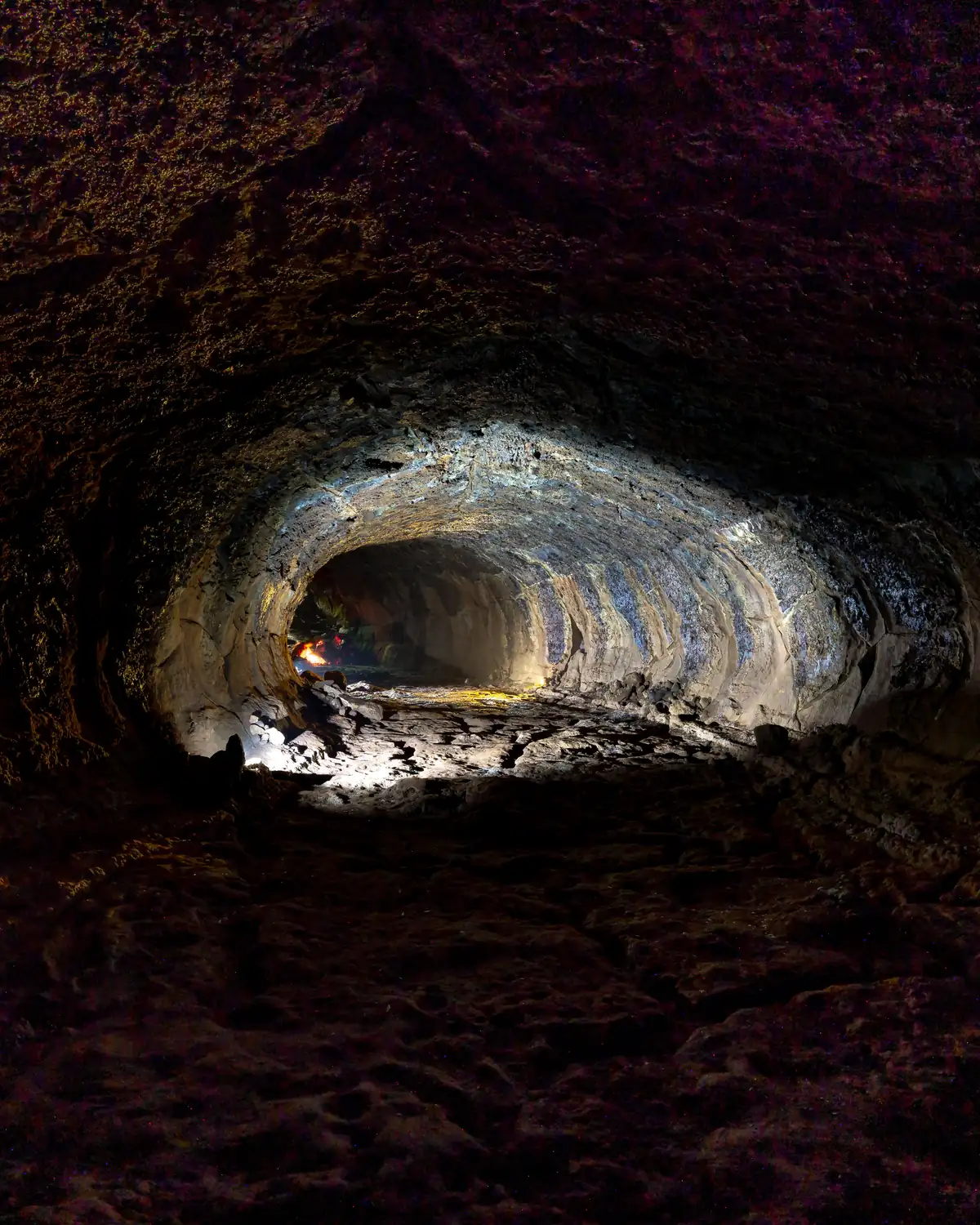
A lava tube forms when the surface of a lava flow cools and hardens while molten lava continues beneath. If the interior drains, it leaves a tunnel. Its walls may preserve flow textures, linings and collapse features. Calling it “dissolved by groundwater” would erase the volcanic mechanism.
Sea caves form where waves, hydraulic pressure and abrasion exploit weaknesses in coastal rock. They can occur in many lithologies. Wind can enlarge openings in some settings, and talus caves occupy spaces between fallen blocks. Glacier caves are passages within or beneath ice, reshaped rapidly by meltwater and ice motion; they are not the same as permanent ice deposits inside a rock cave.
The names need one more boundary. NPS distinguishes a glacier ice cave, whose passage is formed in ice, from an ice cave, which is a rock cave that retains perennial ice. The first can migrate or collapse as meltwater and the glacier move; the second owes its ice to the rock cavity's temperature and airflow. Neither label identifies the limestone-dissolution sequence described above.
The shared feature is a natural underground void large enough for entry, but classification boundaries vary. Origin must be inferred from rock, geometry, deposits and setting rather than appearance alone.
A cave is also a living, vulnerable watershed
Karst conduits move water quickly and provide little filtration compared with many porous aquifers. USGS notes that karst aquifers are productive and vulnerable to contamination. What enters a sinkhole can reach a spring with surprising speed. Surface land use and underground water quality are inseparable.
Caves host specialized organisms and large microbial communities. Bats can transport nutrients, while cave-adapted species may have restricted ranges. White-nose syndrome has devastated North American bats and can be spread between sites on contaminated gear. Cave conservation rules are therefore part of the science, not bureaucracy added after the wonder.
Human presence changes caves through lint, light, carbon dioxide, touching, broken formations and altered airflow. A stalactite is not “dead rock” available as a souvenir. It is part of a protected geologic archive and an active mineral-water system.
Exploration created knowledge—and a record of risk
Early speleologists mapped darkness with compasses, survey tapes, lamps and notebooks. Édouard-Alfred Martel’s late nineteenth-century expeditions helped establish speleology as systematic study, but cave knowledge also includes long histories of local and Indigenous presence that must not be reduced to a European “discovery” claim.
Modern cave maps combine calibrated survey instruments, laser scanning, dye tracing, hydrology and geophysics. A line on a map is evidence of measured connections, not permission to enter. Unmapped voids can exist beyond sumps, collapses or openings too small for people.
This article gives no cave-entry procedure. Flooding can arrive from rainfall far away; air can be hazardous; vertical drops and unstable rock are unforgiving; fragile habitats are easily damaged. Visit only managed sites or work with authorized trained teams under local rules.
Scientists read a cave backward
A cave wall presents overlapping clues. Scallops can record flow direction and approximate hydraulic conditions if interpreted with scale. Sediments may preserve floods or long quiet intervals. Gypsum can indicate sulfuric-acid processes. Passage levels can connect to former valley elevations. Speleothem dates may bound when a passage was already air-filled, not necessarily when initial dissolution began.
No single clue dates “the cave.” A network can contain passages created at different times and by different waters. Later events overprint earlier ones. Dating a speleothem tip, a sediment or a volcanic layer answers a specific event question.
The best reconstruction makes its uncertainty visible: sampled point, analytical error, assumptions about closed-system chemistry, alternative passage origins and the difference between the age of bedrock and the age of the void.
Water chemistry is measured along a moving path
Investigators sample rain, soil gas, drip water, cave streams and springs rather than treating “the water” as one substance. They measure temperature, pH, electrical conductivity, alkalinity, dissolved calcium and carbon isotopes. Dye tracing can reveal a connection between a sink and a spring, but recovery depends on flow, storage and detection; a missing dye signal does not prove there is no path.
Saturation indices estimate whether a water is thermodynamically positioned to dissolve or precipitate a mineral. They are model results built from measured chemistry and activity corrections, not direct pictures of a reaction front. A water supersaturated with respect to calcite may still precipitate slowly if kinetics, inhibitors or lack of nucleation sites intervene.
Cave air matters too. Visitor breathing, seasonal ventilation and pressure changes alter carbon dioxide. Drip rates respond to recharge with delays that can range from rapid fracture flow to long storage in rock. That is why a single bottle collected on one tour cannot explain a stalagmite’s history.
The room can enlarge by collapse without being born by collapse
Once dissolution has created a void, stress concentrates around it. Beds and joints define blocks that may fail from the ceiling or walls. Breakdown can turn a narrow passage into a chamber and produce a talus pile whose volume occupies much of the floor. Continued dissolution may remove some debris; other blocks remain as a record of mechanical modification.
This distinction matters in sinkhole reporting. A sudden surface collapse may connect to an existing opening, while slow subsidence can occur as soil migrates into smaller voids. Both involve underground loss of support, but their geometry, warning signs and engineering response differ. Only site investigation can diagnose a specific depression; photographs and generalized cave diagrams cannot.
Surface repair alone may conceal continuing subsurface movement. Property decisions require licensed geotechnical and hydrogeological assessment, not a cave article or an online sinkhole checklist.
The cathedral is a plumbing history
A solution cave begins when chemically active water finds a connected weakness. Dissolution enlarges selected routes. Flow responds, feeding back into enlargement. Regional erosion or water-table change drains some passages. Collapse reshapes them. Only then may mineral-bearing drips decorate the air-filled space.
Other caves reverse or replace pieces of that sequence. Sulfuric acid rises; lava drains; waves attack; ice melts. The word cave names the resulting space, not a universal recipe.
That is why a chamber can be both monumental and unfinished. Water still crosses the boundary between surface and stone. A drop at the ceiling carries today’s soil carbon, yesterday’s rain and a few dissolved ions into a void whose first route may have opened millions of years earlier. The cave is not an empty place. It is a landscape’s hidden circulation made large enough to enter.
Frequently asked questions
Does an underground river carve every cave?
No. Many limestone caves involve groundwater dissolution, sometimes while passages are completely water-filled. Other caves form from sulfuric acid, lava, waves, ice or spaces between blocks.
Why does carbon dioxide help dissolve limestone?
Dissolved CO₂ participates in carbonate equilibria that supply acidity and allow calcium and bicarbonate to remain in solution.
What is the difference between a stalactite and a stalagmite?
A stalactite hangs from a ceiling; a stalagmite builds upward from a floor beneath a drip. Both are deposits, not the primary void-making tools.
How long does a cave take to form?
There is no universal rate. Initial enlargement, conduit breakthrough, drainage, collapse and decoration occur on different schedules controlled by hydrology, chemistry and landscape change.
Can a cave be older than its stalactites?
Yes. A passage commonly must drain and contain air before calcite speleothems grow, so a dated deposit can set a minimum age for that open phase, not the first dissolution.
Are sinkholes collapsed cave roofs?
Some are, but many form by gradual dissolution or subsidence of sediment into openings. “Sinkhole” covers multiple mechanisms.
Are caves safe to explore without a guide?
No general article can make wild-cave entry safe. Flood, fall, air, navigation, disease and conservation risks require authorization, training and local expertise.
Why are karst aquifers vulnerable?
Water can move rapidly through connected fractures and conduits with limited natural filtration, carrying surface contamination toward wells and springs.
Sources & further reading
This explainer was prepared through desk research using the sources below; established findings are distinguished from open questions in the text. See our editorial methodology.
- USGS, Karst Aquifers — soluble-rock karst, conduit hydrology and contamination vulnerability.
- NPS, Solution Caves — carbonic-acid formation and fracture enlargement.
- NPS, How Mammoth Cave Formed — passage levels, surface drainage and long landscape history.
- NPS, Speleothems — deposition after passages enter the aerated zone; formation types.
- NPS, Cave/Karst Systems: Carlsbad Caverns — sulfuric-acid speleogenesis and later decoration.
- Palmer (1991), GSA Bulletin, Origin and morphology of limestone caves — recharge, flow and passage-pattern controls.
- USGS, Groundwater Quality in Karst Aquifers — transport and vulnerability context.
- NPS, Cave and Karst Resources — conservation and biological context.
- USGS, Volcano Watch — Lava tubes (1996): how flowing lava develops insulated conduits.
- NPS, Ice Caves — distinction between glacier ice caves and rock caves containing perennial ice.
Spotted an error? We correct verified mistakes promptly — email contact@flashscience.org.
Continue exploring