Science explained · Technology & Engineering
How Does an LED Produce Light?
Why can a crystal’s energy structure decide the color of light it emits?
Explore the sections in this article
A semiconductor is neither an ordinary wire nor an insulator
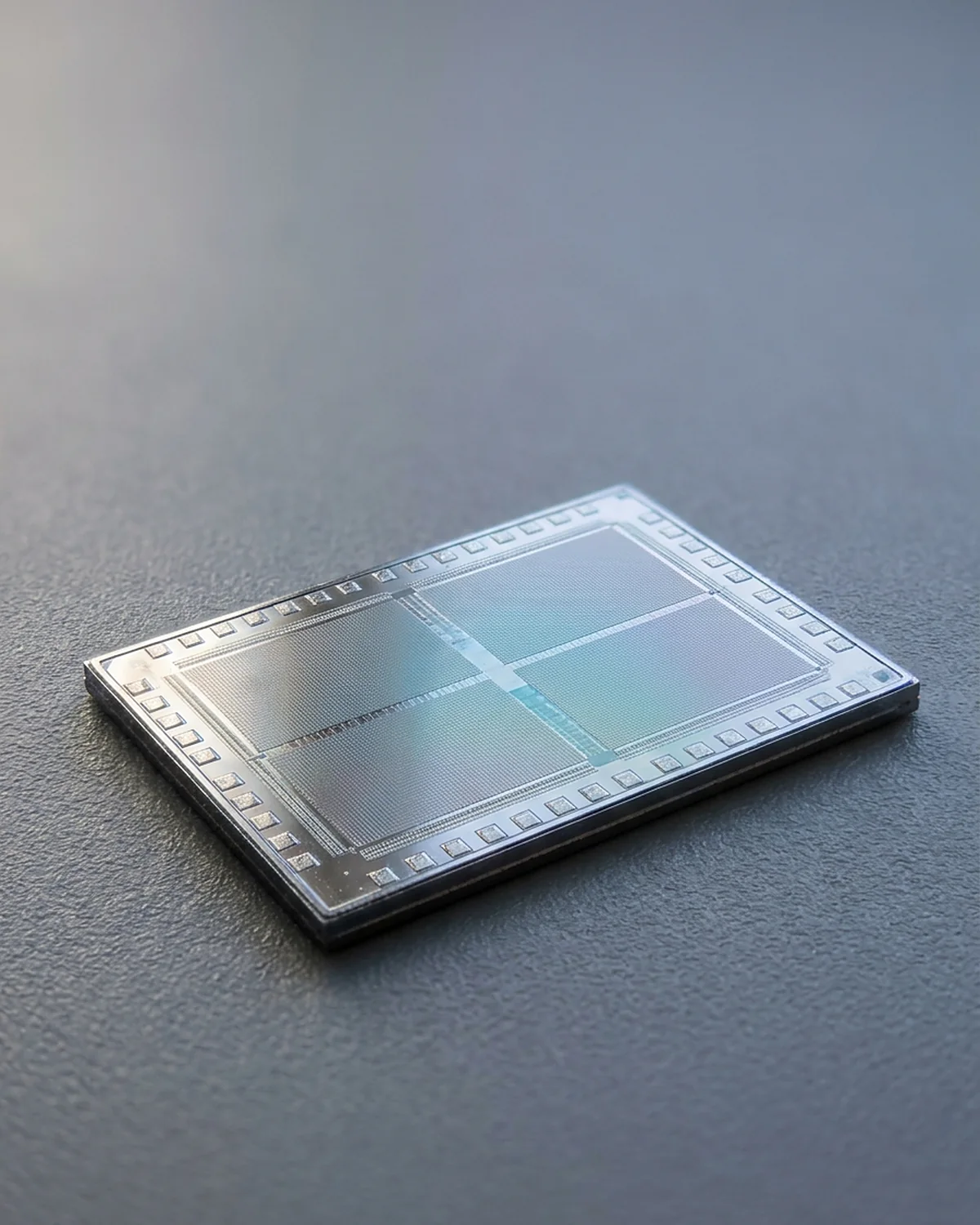
In a crystal, electrons occupy allowed energy bands separated by ranges with no available states. The valence band contains states associated with bonding; the conduction band contains mobile states that can carry current. The energy separation is the bandgap.
Pure semiconductor material can be altered through doping. Donor impurities produce an n-type region with mobile electrons as majority carriers. Acceptor impurities produce a p-type region in which empty states called holes behave as positive mobile carriers. A hole is not a tiny positive particle drilled into the crystal; it is a useful description of missing electron occupancy moving through a nearly filled band.
Join p-type and n-type regions and carriers initially diffuse across the boundary. Fixed ionized dopants create an electric field and a depletion region that opposes further diffusion. The resulting p–n junction conducts asymmetrically.
Forward bias brings carriers into the active region
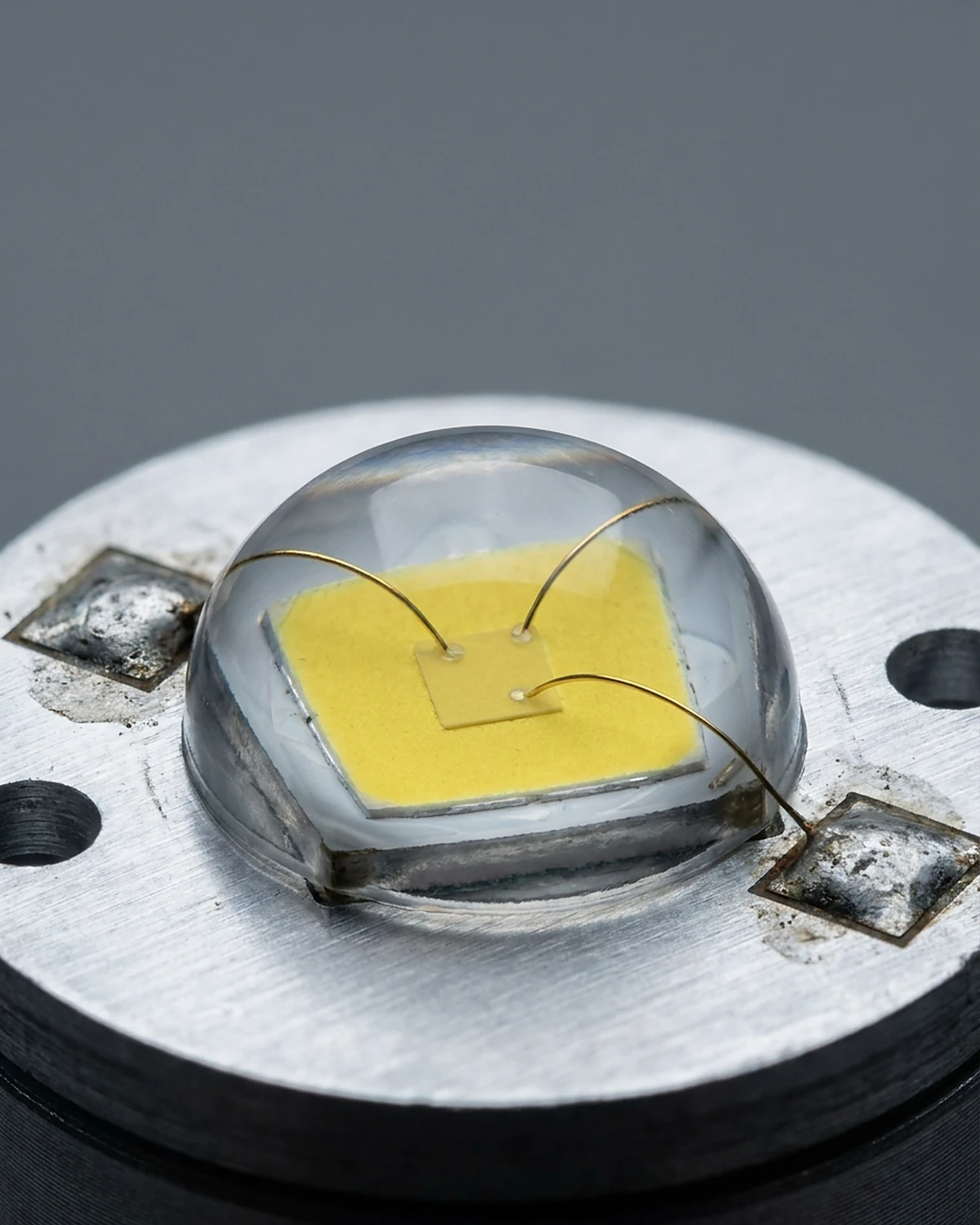
Connect the p side toward a positive electrical potential and the n side toward negative potential. This forward bias lowers the junction barrier and injects carriers. Electrons move from the n side toward the junction; holes move from the p side. In the active region, electrons can transition into available lower-energy states associated with holes.
The lost electronic energy must go somewhere. In a radiative recombination, it emerges as a photon. In a nonradiative transition, it becomes lattice vibration—heat—or is captured by a defect. LED materials and structures are designed to favor radiative recombination and confine carriers where emission is likely.
The common sketch of an electron falling from one horizontal line to another is an energy diagram, not a picture of a marble dropping through space. Modern LEDs use layered semiconductor structures, quantum wells, contacts and optical surfaces. Carrier distributions and quantum-mechanical transition probabilities determine the spectrum.
Bandgap links material to color
Photon energy is:
E = hf = hc/λ,
where h is Planck’s constant, f is frequency, c is light speed and λ is wavelength. A convenient conversion is approximately:
E in electron-volts ≈ 1240 / wavelength in nanometers.
For blue light at 450 nm, E ≈ 1240/450 = 2.76 eV. For red light at 630 nm, E ≈ 1240/630 = 1.97 eV. The shorter-wavelength blue photon carries more energy.
An emitting transition near a material’s bandgap therefore ties composition to color. Aluminum gallium indium phosphide alloys support efficient red-to-yellow emission; indium gallium nitride systems support green and blue. Composition, strain, quantum-well thickness, temperature and device design shift the exact spectrum. An LED does not emit one infinitely sharp wavelength.
Voltage and photon energy are related but not identical in a working device. A forward voltage of roughly three volts for a blue LED is plausible because one electron crossing three volts changes electrical potential energy by three electron-volts, but contacts, resistance, carrier transport and losses matter. Multiplying voltage by current gives electrical power, not the energy of an individual emitted photon.
Direct bandgaps make light more likely
Energy alone is not the whole transition. Electrons in a crystal also carry crystal momentum. In a direct-bandgap semiconductor, the conduction-band minimum and valence-band maximum align in momentum space, allowing efficient photon emission without another particle carrying much momentum.
Silicon has an indirect bandgap. Recombination generally also needs a lattice vibration, making ordinary silicon a poor light emitter. That is why the material dominating digital chips is not automatically the best material for visible LEDs. Gallium arsenide, gallium phosphide alloys and gallium nitride families enabled efficient emission in different colors.
The phrase “an electron and hole collide” is a serviceable first image, but it can imply classical balls. Recombination is a transition between quantum states in a many-particle solid. The picture worth carrying is probability distributed across energy bands, not a miniature solar system with particles in orbit.
Blue was the missing practical piece
Red LEDs appeared early, and Nick Holonyak Jr. and S. F. Bevacqua reported visible coherent emission from a gallium arsenide phosphide junction in 1962. Efficient bright blue light proved much harder. Gallium nitride crystals were difficult to grow with low defects, and reliable p-type material was a stubborn obstacle.
Isamu Akasaki, Hiroshi Amano and Shuji Nakamura received the 2014 Nobel Prize in Physics for the invention of efficient blue light-emitting diodes. Blue completed a path to bright, energy-efficient white sources and full-color displays. The achievement depended on materials growth, doping and heterostructure engineering, not merely choosing a blue pigment.
This history is also a useful correction to innovation mythology. Practical technologies emerge from long chains of crystal growers, measurement scientists, device physicists, manufacturing teams and earlier discoveries. The Nobel recognizes decisive contributions, not every contributor.
Most “white LEDs” do not emit one white photon
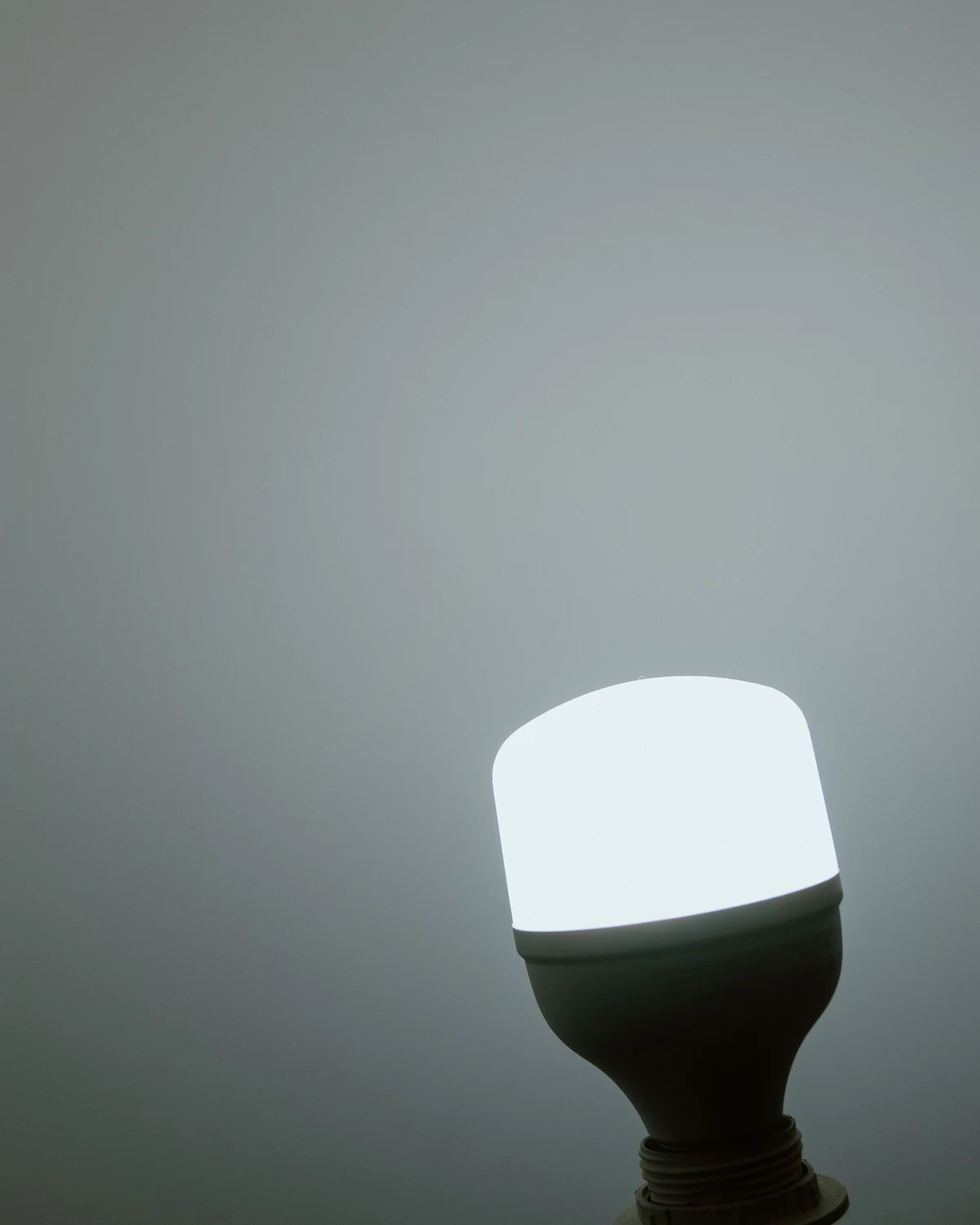
White is a visual perception produced by a spectrum stimulating the eye’s cone responses. A common lamp uses a blue InGaN LED plus a phosphor. Some blue photons pass through. Others are absorbed by phosphor material and re-emitted at lower energies across green, yellow or red wavelengths. The mixture appears white.
Because the re-emitted photons have lower energy, the difference becomes heat; this is the Stokes loss. Spectrum design balances luminous efficacy, color rendering, correlated color temperature, stability and cost. A cool-white lamp may emphasize blue and green-yellow output; a high-quality warm lamp needs sufficient red content.
Another approach combines red, green and blue LEDs. It allows tunable color but requires control to maintain white as devices age and heat. Ultraviolet-pumped phosphors and multi-channel systems exist as well.
“White LED” therefore describes a system output. It does not identify one universal semiconductor or spectrum.
Efficiency must be followed through several gates
Internal quantum efficiency asks what fraction of injected carriers produce photons inside the device. Extraction efficiency asks how many photons escape rather than being absorbed or trapped by total internal reflection. Their combination contributes to external quantum efficiency.
Wall-plug efficiency compares optical power leaving with electrical power entering. Lamp efficacy, measured in lumens per watt, weights optical output by human visual sensitivity. Two sources with equal optical watts can have different lumens because the eye is more sensitive near green-yellow wavelengths than deep red or blue.
This distinction prevents an easy mistake: lumens per watt is not a direct percentage of energy converted to light. It is a photometric measure of visually weighted output. Color quality and spectrum matter; maximizing one number can produce unpleasant or inadequate illumination.
DOE notes that LEDs use less energy and last longer than incandescent technologies in suitable products, but product performance varies. Drivers, optics, operating temperature and premature component failure influence a lamp’s real life.
LEDs still get hot
An incandescent filament emits light because it is extremely hot. An LED junction emits through recombination, yet nonradiative losses, electrical resistance, driver losses and trapped light create heat. That heat is concentrated in a small die.
High junction temperature can reduce light output, shift color, accelerate phosphor and packaging degradation, and shorten life. The LED conducts heat through its package to a circuit board, heat spreader, fins and surrounding air. A lamp’s base may feel hot even though its light-producing surface is cooler than a filament.
Thermal resistance is often expressed in degrees Celsius per watt. If a junction-to-case thermal resistance were 5 °C/W and the device sent 2 W of heat through that path, the junction would be about 10 °C above the case from that path alone. This is a bounded illustration, not a lamp specification; case-to-ambient resistance and transient heating add further rises.
Enclosing an LED replacement lamp in a fixture not rated for it can trap heat. Consumer safety and compatibility instructions matter more than the abstract efficiency of the die.
More current does not produce proportional light forever
At low-to-moderate drive, increasing current raises photon production. At high current density, internal efficiency can decline—a behavior called efficiency droop, particularly studied in nitride LEDs. Carrier leakage, Auger recombination, heating and other mechanisms have been investigated; their relative importance depends on structure and conditions.
Manufacturers use larger emitting areas, multiple dies, improved quantum wells and driver strategies. “An LED converts every electron into a photon” is never an accurate universal model. Even when internal efficiency is high, extraction, phosphor conversion, optics and driver losses remain.
Current must be controlled
An LED’s current rises steeply with forward voltage over its operating region. Connecting a bare LED directly across a voltage source can exceed its safe current, causing heating and failure. Products use a resistor for simple low-power indicators or an electronic constant-current driver for lighting.
On alternating-current mains, the driver converts and regulates power. Driver quality affects flicker, power factor, dimming, electromagnetic interference and lifetime. The safest consumer lesson is not to build a mains driver. Use certified finished products and follow fixture and dimmer compatibility guidance.
Pulse-width modulation can dim an LED by switching current on and off rapidly. The average light falls with duty cycle, but flicker visibility and camera banding depend on frequency, modulation depth and exposure. Analog current reduction is another method and can change color or efficiency differently.
LEDs age rather than always “burn out” suddenly
Light output usually depreciates over time. Heat, current, materials and environment affect the rate. Industry lifetime claims often use lumen-maintenance projections, such as the time to a specified fraction of initial output, rather than waiting for every lamp to go dark.
The LED die may outlast its driver or another package component. A claimed number of hours depends on test conditions and statistical projection; it is not a countdown guaranteed for every product. Switching frequency is generally less damaging to solid-state sources than to filament lamps, but drivers and thermal cycling still matter.
A safe observation: compare spectra and heat without opening anything
Use only intact, certified low-voltage or household lamps as directed. Shine a white LED and an incandescent source on a compact disc from a distance; the disc’s grooves can spread colors. A phosphor-converted LED may show a structured blue-plus-broad spectrum, while an incandescent source appears more continuous. Never stare into a bright LED or use a laser.
After equal operating time, switch off and allow safe handling according to instructions. Observe that both systems create heat, though at different locations and quantities. Do not dismantle a mains lamp: capacitors can retain dangerous voltage.
The photon inherits a material decision
An LED begins with band engineering. Doping creates carrier supplies; forward bias injects them; quantum wells confine them; recombination releases photons; surfaces and optics help those photons escape; phosphors may transform the spectrum; thermal design carries losses away.
The light is not produced because a crystal was told “blue.” Its allowed states make certain energy changes probable. By selecting and fabricating the material, engineers choose the neighborhood of photon energies before any particular photon exists.
That is why a lamp can be both a quantum device and an ordinary household object. Every room illuminated by an LED is filled with evidence that solid-state energy levels can be designed, manufactured and controlled at enormous scale.
Light quality is a spectral engineering problem
Human vision compresses a spectrum into color sensations. Two sources can look like the same white on a blank wall yet render colored objects differently, a phenomenon related to metamerism. A narrow red fabric reflects only wavelengths the lamp provides; if a nominally white LED has little deep-red output, the fabric can appear dull even when total lumens are high.
Color rendering metrics compare how test samples appear under a source against a reference. The traditional general color-rendering index compresses several samples into one value and can miss important spectral differences. IES TM-30 uses a larger set of color samples and reports fidelity and gamut information. Neither number alone decides whether a source suits a museum, hospital, road or living room. Visual task, circadian timing, camera response and preference change the requirements.
Correlated color temperature, expressed in kelvins, describes the closest point on a reference locus for near-white light. It is not the operating temperature of the LED. A “2700 K” lamp can be physically far cooler than 2700 kelvins; the label describes chromatic appearance similar to a warm incandescent source.
Measurement prevents efficiency from becoming a color trick
Photometry weights optical power by the standardized sensitivity of human daytime vision. Radiometry measures physical radiant power without that visual weighting. Spectroradiometers measure output versus wavelength; integrating spheres collect light emitted in many directions; calibrated standards connect readings to SI units.
Temperature, drive current, warm-up time and optical geometry must be controlled. Measuring only directly in front of a directional LED can exaggerate total output. Comparing bare packages with complete lamps ignores driver and optical losses. NIST measurement work and standardized test methods exist because small systematic errors can become large commercial claims across millions of products.
For readers, the practical lesson is simple: compare lumens, power, color rendering, color temperature, beam and compatibility for the actual task. “Brightest chip” and “best lamp” are not the same result. The photon mechanism begins the story; perception, measurement and luminaire design finish it.
Explore the idea
Try it: compare the energy of different colours
Change a light wavelength to calculate the energy of one photon. Shorter wavelengths carry more energy per photon.
Photon energy E = h × c ÷ wavelength; divide joules by the elementary charge to obtain electronvolts.
This calculates photon energy, not LED electrical consumption, brightness or efficiency. An actual LED emits a band of wavelengths.
Model background: NIST: the defining SI constants
Frequently asked questions
Why do LEDs need a resistor or driver?
Small voltage changes can cause large current changes. A resistor or regulated driver limits current to a safe operating range. A finished lamp includes this function; a bare component does not.
Why are blue LEDs usually about three volts and red LEDs lower?
Blue photons have greater energy, corresponding to larger-bandgap materials and generally higher forward voltage. Device construction and current also affect voltage, so color does not specify one exact value.
Are LEDs cold to the touch?
Not necessarily. Their light is not generated by an incandescent filament, but electrical and optical losses heat the junction, driver and heat sink. High-power LED products can become hot.
Can an LED emit ultraviolet or infrared?
Yes. Semiconductor materials can be designed for ultraviolet, visible or infrared emission. Invisible emission needs appropriate safety controls because the blink response may not protect the eye.
Why do some LED lights flicker on camera?
Their drivers may modulate current at mains-related or pulse-width-modulation frequencies. A camera’s rolling shutter and exposure sample that variation as bands or flicker, even when a person notices little.
Do LEDs suddenly burn out?
They can fail abruptly, often because of a driver or connection, but many gradually lose output or shift color. Lifetime ratings usually describe lumen maintenance under test conditions.
Why do white LEDs look different from one another?
Blue-chip wavelength, phosphor blend, optics and manufacturing variation change spectrum, correlated color temperature and color rendering. Two lamps labeled “warm white” need not match perfectly.
Are all LED lamps more efficient than every fluorescent lamp?
No universal comparison follows from the label alone. Modern LED products are often highly efficient, but efficacy, optics, ballast/driver losses, temperature and application determine system performance.
Sources & further reading
This explainer was prepared through desk research using the sources below; established findings are distinguished from open questions in the text. See our editorial methodology.
- Nobel Prize, The Nobel Prize in Physics 2014 — efficient blue LEDs and their enabling role in bright, energy-saving white light sources.
- U.S. Department of Energy, LED Lighting — solid-state lighting, efficiency, lifetime and product context.
- OpenStax, University Physics Volume 3, Semiconductor Devices — semiconductor bands, doping and p–n junction foundation.
- Holonyak & Bevacqua, “Coherent (Visible) Light Emission from Ga(As1−xPx) Junctions,” Applied Physics Letters 1, 82–83 (1962) — early visible semiconductor junction emission.
- NIST, Solid-State Lighting Metrology — optical, spectral and photometric measurement context for LEDs.
- U.S. Department of Energy, Solid-State Lighting R&D Plan — LED package, efficacy, droop, color and thermal research context; verify edition at publication.
- U.S. Department of Energy, Metrics and Test Methods — current listing and scope of ANSI/IES LM-80 for package, array and module flux/color maintenance.
- Illuminating Engineering Society, ANSI/IES TM-30-24 — current method reporting color fidelity, gamut and hue-specific rendition.
Spotted an error? We correct verified mistakes promptly — email contact@flashscience.org.
11 September 2026 update: added a sourced interactive model and clarified its assumptions. Editorial change log
Continue exploring