Science explained · Life & Chemistry
How Do Fireflies Make Light?
How does a living lantern turn chemical free energy into a precisely timed flash without becoming a tiny hot bulb?
Explore the sections in this article
"Cold light" describes a contrast, not zero heat
An incandescent filament must become hot enough to radiate visible light, shedding much of its input in infrared. Firefly bioluminescence does not rely on bulk material at a glowing temperature. Chemical energy is routed directly into an electronically excited product, so the fraction emerging as visible photons can be high and the insect does not need a hot lantern.
That does not make the conversion perfectly efficient. Chemical side reactions, non-radiative relaxation, enzyme inactivation and biological support costs consume energy. Published quantum-yield estimates have changed with measurement methods. Quantum yield counts photons per reacted molecule under defined conditions; it is not identical to whole-animal energy efficiency. "Nearly 100 percent efficient" is an outdated simplification.
The phrase cold light is still useful if bounded: the organ produces visible light with little temperature rise compared with combustion or an incandescent bulb. It should not be illustrated with ice, nor used to claim that no energy becomes molecular motion. The chemically excited state is real precisely because energy has been invested.
ATP activates; it is not the glowing substance
The luciferase reaction proceeds in two broad stages. First, luciferin reacts with ATP in the enzyme's active site, forming luciferyl adenylate and releasing pyrophosphate. This activation makes the substrate ready for the oxygen-dependent chemistry. In the second stage, oxygenation and a sequence of short-lived intermediates lead to carbon dioxide, AMP and excited oxyluciferin.
The excited product has electrons in a higher-energy configuration than the relaxed product. As it returns to a lower electronic state, a photon can carry away the energy difference. The enzyme shapes the reaction environment and influences which emitter state forms. It is a catalyst, not a fuel that is burned on every flash.
ATP is often called the cell's energy currency, but the metaphor can mislead. The lantern does not convert an ATP molecule directly into one visible speck as if feeding a coin into a lamp. ATP participates in substrate activation, and the reaction network includes enzyme, luciferin, oxygen, magnesium ions and cellular regeneration pathways. Stoichiometric equations are maps of matter, not animations of individual colored balls colliding in open space.
Color belongs to the emitter and its molecular room
Many familiar fireflies emit yellow-green light, but beetle bioluminescence spans green through yellow and into orange-red among species and conditions. Photon energy and wavelength are inversely related. The identity and electronic state of oxyluciferin, the luciferase active-site environment, protonation, polarity and other microenvironmental factors influence the spectrum.
This is not color produced by a tinted shell laid over a universally white lamp. Optical tissues can affect escape and direction, but molecular emission already has a spectrum. Mutating luciferase or changing reaction conditions in vitro can shift color, one reason engineered luciferases are valuable laboratory reporters.
A statement such as "fireflies glow at 560 nanometres" therefore needs a named enzyme, species and condition. A peak wavelength describes a distribution, not a monochromatic laser. Human vision also weights wavelengths differently, so perceived brightness cannot be inferred from photon count alone.
A bounded calculation: one green photon is a tiny energy packet
Take an illustrative photon wavelength of 560 nanometres, representative of yellow-green emission from a commonly studied Photinus pyralis luciferase under particular conditions. Photon energy is:
E = hc/lambda
Using Planck's constant h = 6.626 x 10^-34 J s, light speed c = 2.998 x 10^8 m/s, and lambda = 560 x 10^-9 m:
E = 3.55 x 10^-19 joule per photon
One million such photons carry only 3.55 x 10^-13 J. Conversely, one joule divided into these photons would be about 2.8 x 10^18 photons. This arithmetic explains why a visible signal can consist of an enormous number of individually tiny packets.
It does not calculate the energy cost of a flash. We have not measured photon number, spectral distribution, reaction yield, optical loss or the metabolic cost of making substrates and tissue. The chosen wavelength is illustrative, not universal. The calculation translates color into energy scale and nothing more.
The lantern is living reaction engineering
In studied adult fireflies, the light organ contains photocytes - cells specialized for light production - associated with a tracheal system that delivers gases. Reflective tissue can help redirect light outward. Mitochondria, peroxisome-associated luciferase localization and cellular organization enter the mechanistic picture, but exact layouts and developmental origins differ. One generated cross-section must never stand in for all Lampyridae.
Luciferin, ATP and oxygen must be available in the right place. Products must be handled, and enzyme activity maintained. The transparent or translucent cuticle provides an optical exit. A laboratory tube containing purified luciferase can glow, but a behaving animal requires supply, timing and signaling geometry.
The lantern is also not a hollow chamber filled with luminous fluid. Light is produced inside organized tissue. Popular diagrams often enlarge a single reaction until organ anatomy disappears, or draw glowing molecules flowing like electricity. A faithful visual needs separate scales and explicit transitions between them.
Turning the flash on is harder to explain than making light in a tube
Mix luciferase, luciferin, ATP, magnesium and oxygen under suitable conditions and light follows. A firefly, however, can generate short flashes on a behavioral schedule. Neural activity must influence the chemical reaction quickly enough to shape onset and offset. The precise control chain has been debated for decades.
Oxygen availability is central because the light-producing stage requires it. One influential model proposes that nitric oxide transiently suppresses mitochondrial oxygen consumption near photocytes, freeing oxygen for luciferase. Tracheal end cells and neural signaling are implicated. Yet studies of nitric-oxide synthase expression and lantern physiology have not resolved every species or every temporal detail.
It is safer to say that neural control, oxygen delivery and cellular oxygen use interact than to announce one universal valve. ATP and pH can also affect output, and flash decay may include substrate and product kinetics. What controls a laboratory enzyme trace is not automatically what gates a 100-millisecond living flash.
A flash can be a message, a warning or a lure
In many adult fireflies, light participates in courtship. Flying individuals of one sex may produce a species-typical pattern, and perched responders answer after a characteristic delay. Pattern, interval, flight path, height and habitat can all matter. Continuous-glow species and daytime lineages complicate any universal "male flashes, female replies" script.
Larval light is widely interpreted as aposematic warning in many lampyrids, advertising chemical defenses to predators. Adult signaling likely evolved on top of older defensive luminescence, although evolutionary histories are reconstructed from phylogeny and living traits rather than observed origins.
Some Photuris females imitate the responses of other firefly species and prey on attracted males, acquiring defensive compounds in the process. That well-known case is real but belongs to particular taxa. It does not mean every flash is deceptive or every female is predatory. Communication creates opportunities for both recognition and exploitation.
Synchrony emerges from individuals responding to light
Certain Southeast Asian and North American fireflies produce striking group displays. "They all flash at exactly the same time" again compresses variety. Some systems show near synchrony, others waves or phase patterns, and environmental and behavioral context influence the display.
Mathematical oscillator models can reproduce synchronization when individuals adjust timing in response to neighbors. Field measurements use video, photodetectors and spatial reconstruction to test how local interactions scale into a group pattern. The model is not evidence that an insect solves equations; it is a compact description of repeated timing adjustments.
Artificial light at night can interfere with courtship signaling by reducing contrast or altering behavior. Habitat loss, pesticides and other pressures vary across species and locations. Observers should use low-impact practices recommended by local conservation groups: remain on paths, avoid capture, avoid flash photography and do not alter vegetation. This package proposes no stimulation experiment.
The chemistry became a window into other cells
Firefly luciferase became one of biology's most useful reporter enzymes. Researchers can place a luciferase gene under control of a regulatory DNA sequence, add an appropriate substrate, and use emitted light as a proxy for gene expression or cell location. Luciferase assays also measure ATP because light output depends on it under controlled reagent conditions.
The path from beetle to assay involved decades of biochemical work. William McElroy and colleagues helped establish ATP's role in the mid-twentieth century; purification, cloning of luciferase genes and protein engineering followed. Modern reporters can be brighter, more stable or shifted in color. The firefly was not "designed for medical imaging"; researchers repurposed a biochemical reaction through experimental engineering.
Reporter light is not automatically quantitative in living tissue. Substrate delivery, oxygen, ATP, enzyme amount and absorption or scattering by tissue affect the signal. Red-shifted emission may travel farther through tissue than green light, but calibration and controls remain essential.
Researchers read flashes at several scales
A spectrometer measures wavelength distribution. A photomultiplier or sensitive camera measures intensity over time. High-speed recordings align behavior with a light trace. Microscopy and histology locate structures; biochemical assays isolate reaction steps; electrophysiology tests neural timing. Each creates a partial view.
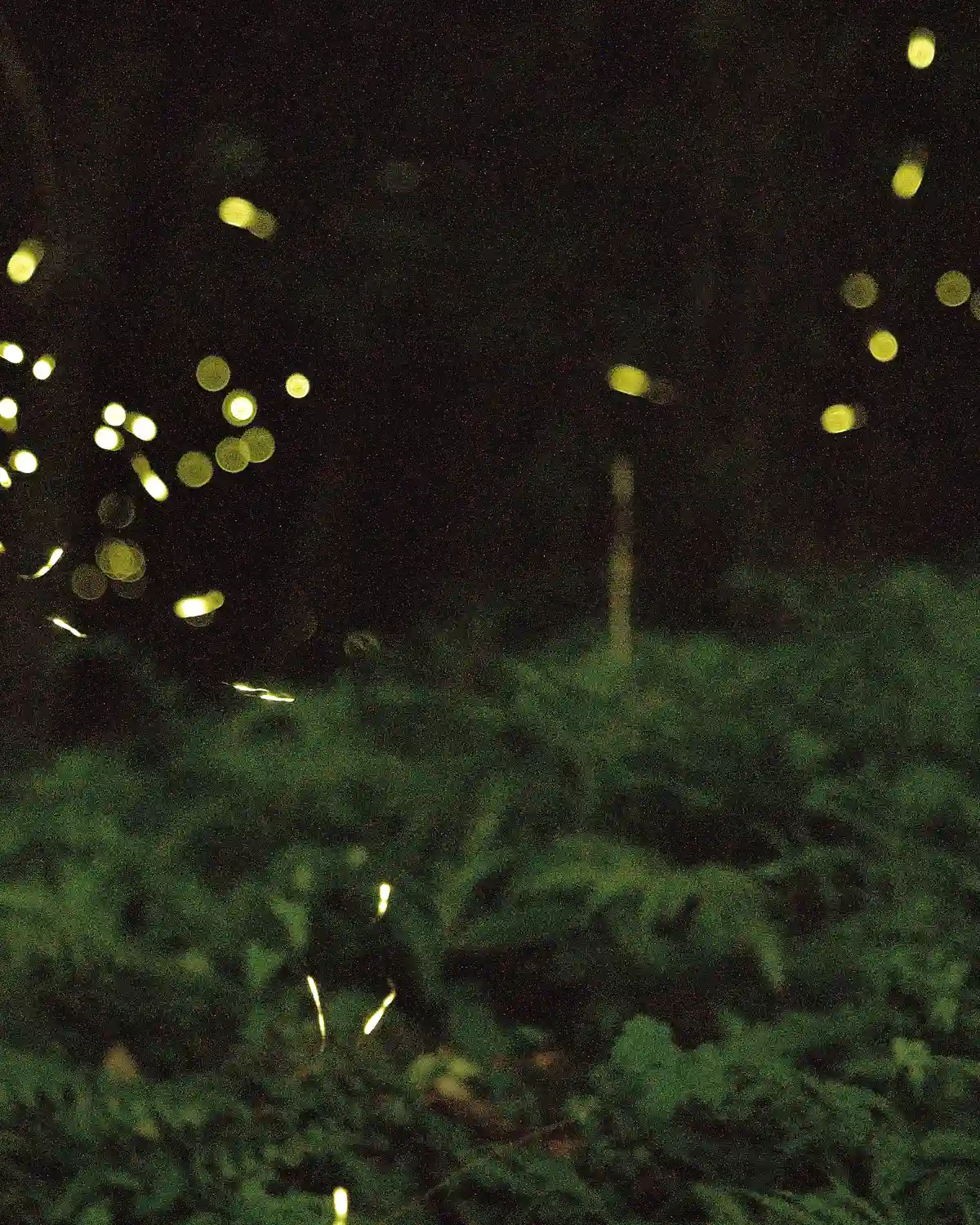
Field researchers also record temperature because flash rates can change with it. They identify species before assigning a pattern. Geographic populations may differ, and individuals can vary. A beautiful long-exposure photograph merges time and cannot by itself reveal exact flash duration or synchrony.
Measurement changes the scene. Bright lights used for focusing can suppress or overwhelm signals. Capture and restraint can alter behavior. Good protocols minimize disturbance and distinguish laboratory mechanism from free-living function. Citizen observations can help map distributions when photographs, timing and location are recorded responsibly, but an app identification is not a biochemical measurement.
The common myths erase different parts of the mechanism
Fireflies do not "store sunlight" during the day. Their photons come from chemical energy released at night or day according to species biology. Luciferin is not phosphorus and the organ is not radioactive. The reaction is not combustion, even though oxygen is used. It does not run without metabolic inputs, and it is not perfectly efficient.
Nor does every flash encode a fixed alphabet. Flash patterns function in contexts shaped by receivers, ambient light and evolutionary history. Calling them Morse code suggests a human one-to-one symbol system. A timed signal can convey species and mate information without representing words.
Finally, bioluminescence did not evolve once for all luminous organisms. Bacteria, fungi, dinoflagellates, cnidarians, fishes and beetles use chemically distinct systems. "Luciferin" and "luciferase" are functional category names, not proof of one shared molecule or enzyme ancestry.
What remains uncertain is properly part of the light
The core Photinus-type reaction is unusually well characterized, yet the identity of the emitting oxyluciferin state and the sources of color shifts have inspired multiple models. In vivo flash control remains an active systems problem. Luciferin biosynthesis and recycling pathways are better understood in some lampyrids than others. Genomic studies continue revising how beetle luciferases evolved from related enzymes.
Ecological uncertainty is equally important. Lampyridae includes more than two thousand described species, many poorly studied. A mechanism demonstrated in one North American species may not govern a continuous-glowing Asian species in every detail. Conservation status cannot be inferred from a decline story elsewhere.
Honesty here improves the explanation. Firm ground includes ATP-dependent luciferin activation, oxygen-dependent oxidation, an excited emitter and photon release. The open ground includes exact control architectures, evolutionary transitions and species-by-species signaling ecology.
A flash is a complete chain, not just a reaction arrow
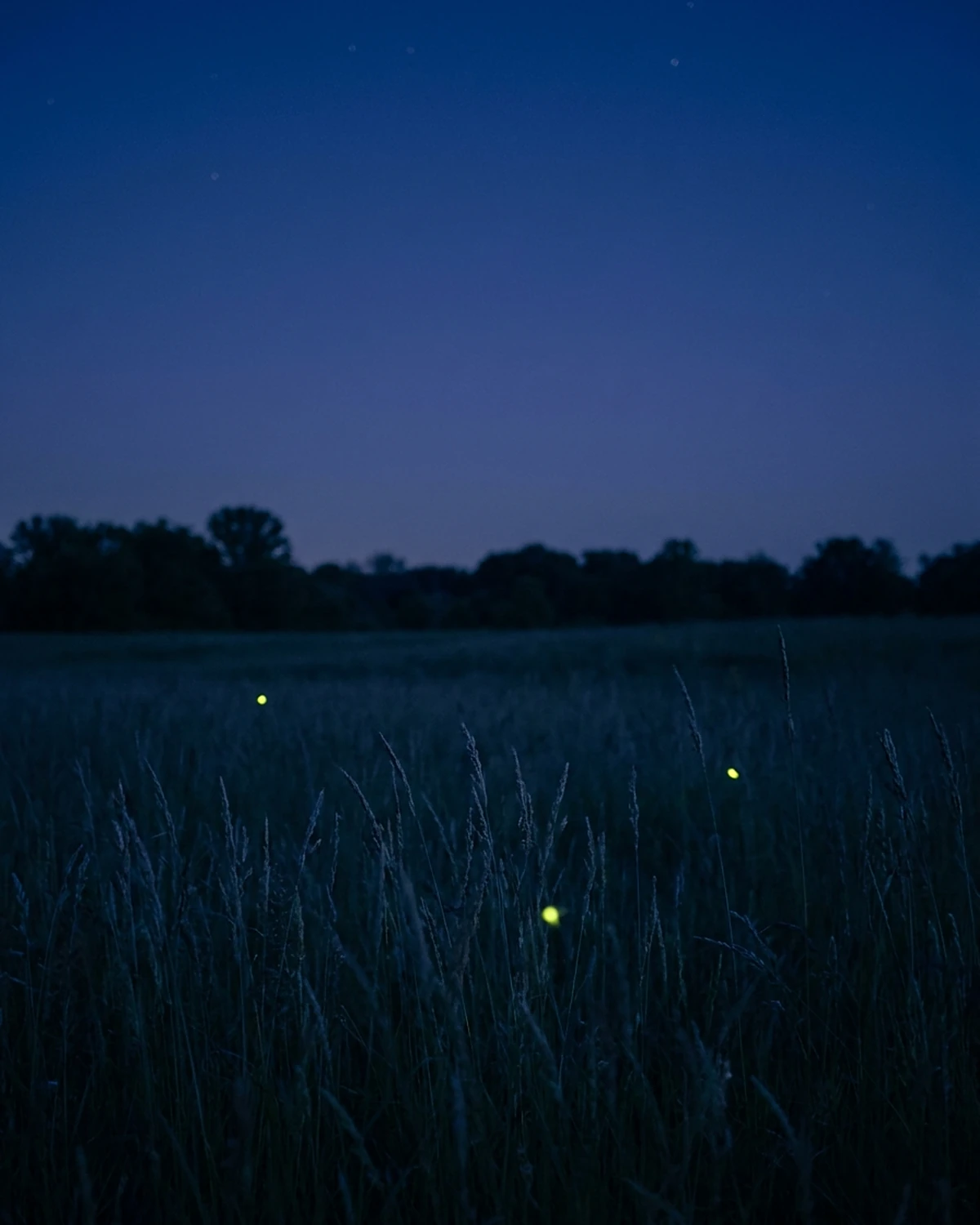
The point above the grass begins with metabolism and a specialized organ. Luciferase binds and activates luciferin. Oxygen-dependent chemistry forms an excited product. Relaxation releases visible energy. Tissue supplies reactants and gives photons an exit. Neural and physiological controls arrange the light in time. Another animal may receive the pattern and change its behavior.
Pull out any link and the familiar flash changes meaning. A glowing test tube proves the chemistry but not the courtship. A timing trace proves behavior but not one oxygen-control model. A photograph proves light occurred but not its spectrum or efficiency.
The firefly's achievement is therefore double. It makes a photon from a molecular energy difference, and it places photons into a sequence that natural selection has made consequential. The summer signal remains wondrous after the metaphor is removed. It becomes more so: a cold-looking point is chemistry, anatomy, neural timing, ecology and evolutionary history compressed into less than a second.
Frequently asked questions
What chemicals does a firefly need to glow?
In the well-studied beetle system: luciferin, luciferase, ATP, molecular oxygen and a suitable ionic/cellular environment. The reaction proceeds through an activated luciferyl intermediate.
Is firefly light 100 percent efficient?
No. It is efficient at producing visible light compared with an incandescent filament, but quantum yield is below 100 percent and whole-organism costs are broader.
Why is the light yellow-green?
The excited emitter and luciferase microenvironment set the emission spectrum. Species, enzymes and conditions can shift it toward green, yellow, orange or red.
How does a firefly switch a flash on and off?
Neural signaling, oxygen delivery/use and reaction kinetics interact. Oxygen-gating and nitric-oxide models have evidence, but no one simple switch is established for every firefly.
Do all fireflies flash to find mates?
No. Many adults use light in courtship, but signaling systems vary; larvae often glow, some adults glow continuously, and some lineages are active in daylight.
Are glowing worms fireflies?
Some "glow-worms" are larval or flightless female lampyrids; others belong to different insect families. Common names do not establish shared anatomy or chemistry.
Can artificial light harm fireflies?
It can disrupt signaling in studied species, while habitat change and chemicals also matter. Effects and conservation status are location- and species-specific.
Can I catch fireflies in a jar?
Observation without capture is the lower-impact choice. Follow local conservation guidance, stay on paths and avoid flash photography or habitat disturbance.
Sources & further reading
This explainer was prepared through desk research using the sources below; established findings are distinguished from open questions in the text. See our editorial methodology.
- Inouye, Firefly luciferase: an adenylate-forming enzyme for multicatalytic functions, Cellular and Molecular Life Sciences (2010) - two-stage chemistry and enzyme evolution.
- Branchini et al., Red-emitting luciferases for bioluminescence reporter and imaging applications, Analytical Biochemistry (2010) - emitter color and engineered enzyme context.
- Ando et al., Firefly bioluminescence quantum yield and colour change by pH-sensitive green emission, Nature Photonics (2008) - modern quantum-yield measurement and spectrum.
- Ghiradella & Schmidt, Fireflies at one hundred plus: a new look at flash control, Integrative and Comparative Biology (2004) - lantern organization and flash-control models.
- Trimmer et al., Nitric oxide and the control of firefly flashing, Science (2001) - nitric-oxide/oxygen-consumption model in studied fireflies.
- Ohtsuki et al., Expression of the nos gene and firefly flashing: a test of the nitric-oxide-mediated flash control model, Journal of Insect Science (2014) - empirical limits and unresolved control.
- Lewis & Cratsley, Flash signal evolution, mate choice, and predation in fireflies, Annual Review of Entomology (2008) - courtship, response diversity and predatory mimicry.
- Lewis et al., A global perspective on firefly extinction threats, BioScience (2020) - artificial light, habitat and species-specific conservation pressures.
- Sarfati et al., Self-organization in natural swarms of Photinus carolinus synchronous fireflies, Science Advances (2021) - measured collective timing and spatial dynamics.
Spotted an error? We correct verified mistakes promptly — email contact@flashscience.org.
Continue exploring