Science explained · Life & Chemistry
Why Is Ice Slippery?
What changes inside a contact only micrometers wide when a shoe, tire or skate begins to slide?
Explore the sections in this article
Real contact hides inside apparent contact
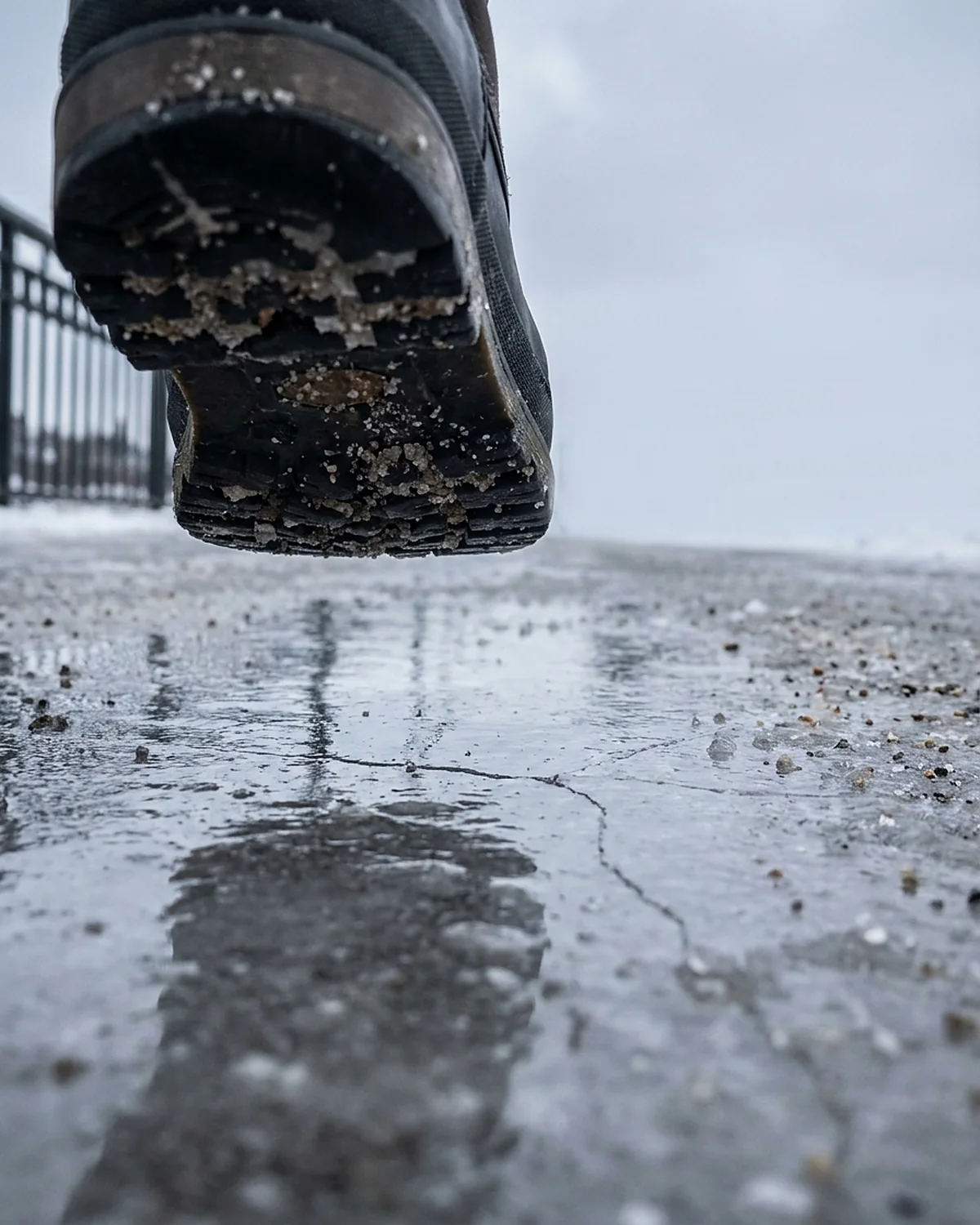
A boot sole may appear to cover hundreds of square centimeters, but microscopic roughness means initial contact occurs at a much smaller collection of high points called asperities. Local pressure at those junctions can be far greater than total weight divided by the visible footprint. Rubber deforms around texture; steel does so much less. Snow grains or grit add a third body between the nominal pair.
Those junctions carry shear stress when sliding begins. Some deform, some fracture and some adhere. The slider may plow through soft ice or climb roughness. Energy dissipated at the interface becomes heat, but it can also be stored briefly in deformation or spent creating cracks and new surfaces.
This is why a single coefficient of friction for “ice” is misleading. A reported coefficient belongs to a specified material pair and test: normal load, velocity, temperature, surface preparation, contact shape, run-in history and environment. Static friction before motion and kinetic friction during sliding need not match. Even repeated passes can polish, warm or contaminate the track.
The crystal surface is not simply bulk ice cut flat
Inside ordinary hexagonal ice, water molecules occupy an ordered oxygen lattice linked by hydrogen bonds, while proton arrangements retain disorder. At a free surface, molecules have fewer neighbors and cannot satisfy the same bonding environment. Experiments and simulations support a structurally disordered, mobile surface region whose properties and thickness depend strongly on temperature and crystal face.
This phenomenon is often called surface premelting or described as a quasi-liquid layer. “Quasi” matters. It need not have the thickness, density, viscosity or molecular structure of bulk liquid water. Near the melting point it may become more liquid-like; far below, disorder can persist on a much smaller scale. Impurities and vapor conditions alter it.
The layer exists without a boot crossing the ice, so friction cannot be its sole cause. But existence does not prove it lubricates every contact. Confinement, shear and heat flux transform the region. A molecularly mobile surface measured without sliding is not automatically the same film under a loaded tire.
Pressure melting is real but usually oversold
For common ice near atmospheric pressure, increasing pressure lowers the melting temperature over a limited pressure range because liquid water is denser than ice Ih. The Clapeyron relation connects the melting-line slope to volume and entropy changes. This makes pressure melting physically legitimate.
It does not make an ordinary person’s average footprint sufficient to melt cold ice. If an 80 kg person distributes weight over 0.030 m², the simple average pressure is:
P = mg/A ≈ 80 × 9.81 / 0.030 ≈ 26,000 Pa = 0.026 MPa
Near 0°C, the melting point decreases by only roughly 0.074°C per MPa. The average-pressure shift would therefore be about:
0.026 × 0.074 ≈ 0.002°C
That is a bounded scale estimate, not a contact model. True asperity pressures can be much higher, load distribution is uneven, ice deforms, and the slope changes with pressure and ice phase. Still, it shows why “your weight melts a water layer” cannot explain a boot sliding on ice many degrees below zero. Local pressure can contribute without being the whole story.
Sliding makes heat exactly where it matters
Friction converts mechanical work into thermal energy. The rate of work at a sliding interface scales as friction force times speed, P = Fv. If a contact experiences an illustrative 40 N friction force while sliding at 2 m/s, the total dissipation is 80 W during that interval. How much heats the ice surface depends on contact area, duration and how heat partitions into the slider, ice and any debris.
A thin near-melting region has little mass, so a short heat pulse can change it substantially. At sufficient speed or repeated passage, frictional heating can produce or thicken meltwater locally. Yet more water does not always mean lower friction. A very thin film can separate asperities; a thicker viscous film can resist shear; capillary bridges can increase adhesion; water can be squeezed away or refreeze behind the contact.
Slow sliding allows more time for heat to conduct away per unit distance. Very fast motion generates power rapidly but shortens residence time at each point. These competing scales help produce friction curves that are not monotonic with speed.
A skate is not just a pressure-melting machine
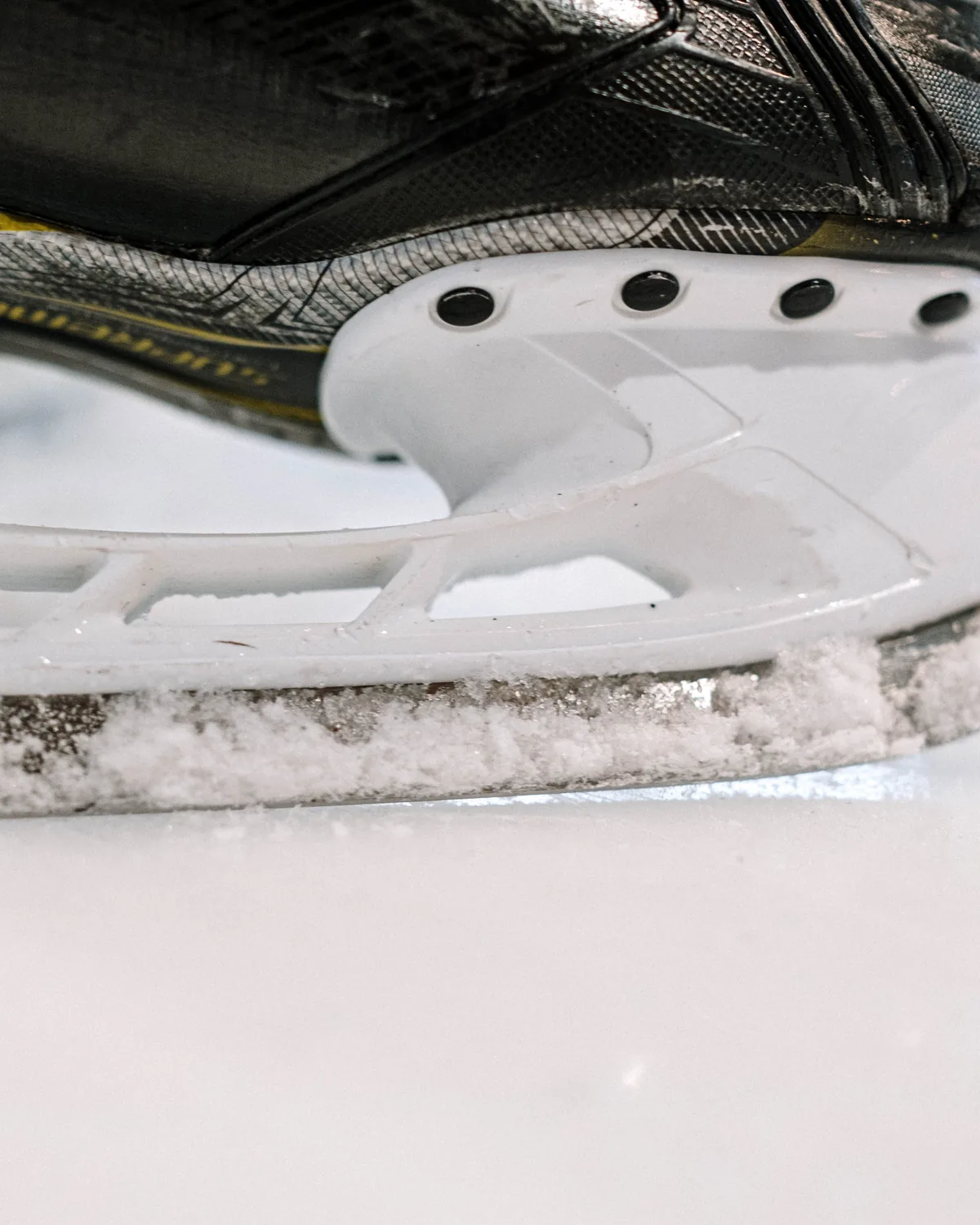
The narrow blades of an ice skate concentrate load, but skating cannot be reduced to their pressure lowering the melting point. Blade curvature, edge geometry, speed, ice temperature and skating maneuver create a coupled thermal and mechanical contact. Frictional heating and the pre-existing disordered surface contribute. The blade can plow or cut ice, especially at its edges, and it must generate lateral grip during turns.
Researchers model melt-film thickness and heat flow beneath moving blades, but measurements are difficult because the contact is narrow, fast and hidden. Water films may be micrometers or less and vary along the blade. A model that fits straight gliding may not describe a hockey stop.
The same caution applies to skiing. A ski deforms over snow grains, compacts and breaks them, and may generate water depending on temperature and speed. Wax changes adhesion, water management and contamination—not by making all snow universally “more slippery.” Equipment explanations must name the regime.
Rubber can grip and lose grip on the same ice
Rubber is compliant and viscoelastic. It conforms to roughness, dissipates energy internally and changes stiffness with temperature. Tread supplies edges and routes loose material or water, but its performance depends on compound and geometry. On rough cold ice, mechanical interlocking and deformation may provide useful resistance. On smooth, wet ice, those mechanisms can shrink while lubrication grows.
Hardening in cold weather reduces some rubbers’ ability to conform. A shoe marketed for winter may combine a cold-flexible compound with texture; metal studs add penetration and scratching. No sole defeats every surface. A stud that bites hard ice can be hazardous on smooth indoor flooring.
Tires add rolling, a changing contact patch, tread blocks and vehicle dynamics. Braking slip heats and polishes differently from free rolling. Anti-lock braking manages wheel slip; it cannot restore dry-road friction. Winter-safety advice should come from transportation and public-safety authorities, not from a molecular explanation used as a stopping-distance promise.
Temperature changes the cast of mechanisms
Close to 0°C, interfacial water is easier to generate and maintain. The disordered surface region is more developed, and modest heating can cross the melting condition. Smooth ice can become extremely slick. But water can also form suction-like or viscous contributions depending on contact and speed.
At lower temperatures, available meltwater generally decreases and ice hardens. Friction may rise because solid–solid interaction, plowing and brittle debris matter more. Yet “colder always means grippier” is not a law. Materials harden, frost morphology changes and snow crystals behave differently. Some experiments find minima or maxima at particular temperature–velocity combinations.
Temperature itself needs a location. Air temperature, bulk ice temperature and interfacial flash temperature can differ. Sunlight can warm a dark contaminant or object while air remains below zero. A thermometer several centimeters away may miss the contact’s thermal history.
Water can lubricate, drag and glue
In hydrodynamic lubrication, a sufficiently thick moving liquid film supports load and separates solids. Many ice contacts are too thin, transient or rough for full hydrodynamic separation; they occupy boundary or mixed regimes. Molecular interactions and asperity collisions remain important.
If water forms a meniscus between surfaces, surface tension and pressure differences can add an adhesive force. Thin films also have viscosity: shearing them consumes energy. At low speeds, capillary and adhesive effects may increase resistance. At other speeds, partial separation lowers it. Thus detecting water does not by itself predict the sign or magnitude of its effect.
Salt complicates the phase behavior by depressing freezing temperature and forming brine. Deicing can loosen bonded ice and prevent refreezing under appropriate conditions, but concentrated brine, dilution, pavement temperature and environmental limits matter. Salt is not instant traction; partially melted slush can remain slippery. Follow local guidance rather than improvising quantities from a phase diagram.
Roughness can save you or trip the model
Roughness increases opportunities for mechanical interlocking and plowing, often raising friction. Sand and grit can create hard contacts on smooth ice. Fresh snow or frost may also raise resistance compared with a polished glaze. But loose particles can roll or shear, and repeated traffic can compact snow into a smooth hard layer.
Polishing is a history effect. A sliding blade or tire can shear off asperities, redistribute water and debris, and leave a smoother track. Successive measurements on “the same” location are therefore not independent unless the surface is renewed. Laboratory tribometers carefully specify track radius, passes and surface preparation for this reason.
Natural ice adds cracks, bubbles, grain boundaries, dust and melt–freeze textures. Lake ice, rink ice and freezer frost are not one substance with one cross-section. Any picture showing a perfectly flat crystal under every scenario hides exactly the variables that make the question interesting.
Michael Faraday saw a surface puzzle before modern instruments
In the nineteenth century, Michael Faraday discussed a liquid-like film at ice surfaces while investigating regelation—the joining of ice pieces in contact. His proposal was controversial and could not be tested at molecular resolution. Later explanations emphasized pressure melting, and frictional heating became another major candidate.
Modern surface-sensitive spectroscopy, atomic force measurements and simulations have returned to the disordered-interface idea with much finer qualifications. Tribometers measure force while controlling speed and temperature. Optical and electrical methods infer films beneath contacts. The historical lesson is not that Faraday “solved” slipperiness. It is that several phenomena—surface disorder, regelation and sliding friction—were easy to collapse into one another.
Scientific progress here has looked less like replacing one wrong answer with one right answer than learning which questions each mechanism can answer. A free surface at equilibrium, two ice blocks joining and a steel blade in motion share water molecules but not boundary conditions.
Cryotribology measures a disappearing interface
Tribology is the study of friction, wear and lubrication. Cryotribology brings those questions to low temperatures. A typical experiment controls a slider’s material, shape, normal force and velocity while measuring tangential force. Ice preparation, grain orientation, roughness, humidity and temperature must be reported.
The interface changes during measurement. Sliding creates heat and debris; the slider carries contamination; water migrates; ice creeps. A sensor measures total force, from which researchers infer contributions using models and additional observations. Film thickness is particularly challenging: inserting a probe can disturb the very gap it seeks to measure.
That is why published coefficients span wide ranges and why a single decimal value pasted into a safety infographic is poor evidence. Uncertainty includes calibration, contact area, temperature control and surface evolution. Reproducibility requires both a number and the recipe for creating the contact.
There is no universal water layer
The most seductive picture is a bright blue ribbon under every foot and blade. It turns a conditional nanoscale-to-microscale interfacial region into a visible puddle, and it quietly selects one mechanism from several. What the evidence actually supports is a set of regimes: disordered surface molecules before motion begins; sparse loaded junctions; frictional heat; a possible water-rich film; and debris and plowing.
Three distinctions are easy to blur and worth holding onto. Heat flow is not the same thing as sliding direction, and neither is the same as applied force. Pressure acts at discrete real contacts rather than spreading evenly across the underside of a boot or a blade. And the molecular scale and the boot scale are separated by so many orders of magnitude that no single view holds both honestly. Any specific film thickness is worth only as much as the experiment that measured it.
Even the word “slippery” needs a measured proxy. Is the concern onset of motion, steady sliding force, braking distance or ability to generate lateral force? Each selects a different part of the response. The ambiguity is real, and it is more useful to sit with it than to settle it with a tidier story than the measurements support.
Slipperiness belongs to the encounter
Ice supplies an unusual surface: crystalline below, increasingly disordered toward its boundary, capable of melting and refreezing near everyday temperatures. Motion supplies shear and heat. Load concentrates stress. The other material supplies its own roughness, compliance and thermal conductivity. Water and debris become temporary third bodies between them.
Change one factor and the balance changes. A skate gliding fast on maintained rink ice can ride a very different interface from a cautious boot on cold rough frost. A tire braking on salt-contaminated glaze writes yet another history. No honest coefficient or microscopic cartoon travels unchanged among them.
Pressure melting is part of the physics, but an average-weight calculation shows its limit. Frictional heating can make water, but water can also increase drag. Surface premelting exists without sliding, but its mobility is not a guaranteed lubricant. The answer is not indecision. It is a map of regimes.
Ice is slippery when a particular contact offers little resistance to the motion being asked of it. That sentence sounds less magical than “a secret water layer.” It is also more useful. It tells us what to measure—and why winter deserves humility.
Frequently asked questions
Is ice always slippery?
No. Friction changes with temperature, speed, load, ice texture, the contacting material, debris and contamination. Rough cold ice can resist motion much more than polished near-melting ice.
Does body weight melt ice under a shoe?
Average footprint pressure lowers the melting point by only a tiny amount. Much larger local asperity pressures may contribute, but pressure melting alone does not explain ordinary slipperiness far below 0°C.
Is there liquid water on ice below freezing?
The surface can contain a thin disordered, mobile region and impurities can create brine. Its properties are not always those of bulk liquid water, and thickness depends strongly on conditions.
Why do skates glide?
Blade geometry, local pressure, frictional heating, surface disorder, possible meltwater and ice deformation all contribute. Their importance changes with speed, maneuver and temperature.
Is colder ice less slippery?
Often friction rises as meltwater becomes harder to generate, but material stiffness, roughness, snow morphology and speed can reverse simple trends. There is no universal cutoff.
Does salt make ice safe immediately?
No. Salt can depress freezing temperature and help deicing within a useful temperature/concentration range, but brine and slush can remain slippery. Follow local product and public-safety guidance.
Why does sand improve traction?
Hard grains can add rough contacts and mechanical interlocking, though loose or displaced grit is not a guarantee and may create other hazards.
Can a friction coefficient predict a person’s fall?
Not by itself. Gait, balance, slope, footwear, surface variation and the distinction between straight and lateral motion all matter.
Sources & further reading
This explainer was prepared through desk research using the sources below; established findings are distinguished from open questions in the text. See our editorial methodology.
- Dash, Rempel & Wettlaufer, The physics of premelted ice and its geophysical consequences, Reviews of Modern Physics — surface premelting framework and thermodynamics.
- Slater & Michaelides, Surface premelting of water ice, Nature Reviews Chemistry — modern review of molecular surface disorder and uncertainty.
- Canale et al., Nanorheology of interfacial water during ice gliding, Physical Review X — nanoscale interfacial layer under sliding.
- Kietzig, Hatzikiriakos & Englezos, Physics of ice friction, Journal of Applied Physics — temperature/velocity regimes and competing mechanisms.
- Rosenberg, Why is ice slippery?, Physics Today — historical and mechanistic synthesis.
- Bowden & Hughes, The mechanism of sliding on ice and snow, Proceedings of the Royal Society A — classic frictional-heating experiments and model.
- Persson, Ice friction: role of non-uniform frictional heating and ice premelting, Journal of Chemical Physics — coupled heating/contact theory.
- NIST Chemistry WebBook, Water — phase and thermophysical reference boundary.
- Petrenko & Whitworth, Physics of Ice — crystal structure, phase behavior and defects.
Spotted an error? We correct verified mistakes promptly — email contact@flashscience.org.
Continue exploring