Science explained · Life & Chemistry
How Does Metal Rust?
How can one wet patch on a piece of iron become a tiny electrical circuit that consumes the metal beneath it?
Explore the sections in this article
Rust belongs specifically to iron
Many metals corrode, but rust is the common name for corrosion products of iron and iron-rich alloys such as carbon steel. Aluminum forms an oxide; copper develops patinas; silver tarnishes. Calling every corrosion product rust erases important differences in protectiveness and chemistry.
Even “rust” is not one compound. Depending on water, oxygen, ions, pH, temperature and aging, products can include iron oxyhydroxides such as goethite and lepidocrocite, oxides such as magnetite, poorly crystalline phases and incorporated contaminants. Their proportions change through wet–dry cycles. Orange, red, brown and black regions do not map neatly to one formula each.
Steel is mostly iron but contains carbon and alloying elements, inclusions and multiple microstructural phases. Manufacturing and welding alter those features. A polished laboratory coupon and a bridge fastener may therefore respond differently in the same nominal environment. The word “metal” in the question must narrow to a specified alloy before the answer becomes predictive.
The anodic half-reaction releases iron
At an anodic site, an iron atom can lose electrons and enter the electrolyte as a ferrous ion:
Fe → Fe²⁺ + 2e⁻
This is oxidation. The electrons do not enter the water as loose sparks. They travel through the electrically conductive metal toward sites where a reduction reaction can accept them. Metal loss occurs at the anode, which may be broadly distributed or concentrated in pits, crevices or coating defects.
The reverse-sounding phrase “positive anode” can confuse readers because electrode signs depend on whether a cell is generating or consuming electrical energy. For a freely corroding galvanic cell, the anodic region is where oxidation and metal dissolution occur. The reaction definition is safer than memorizing a sign.
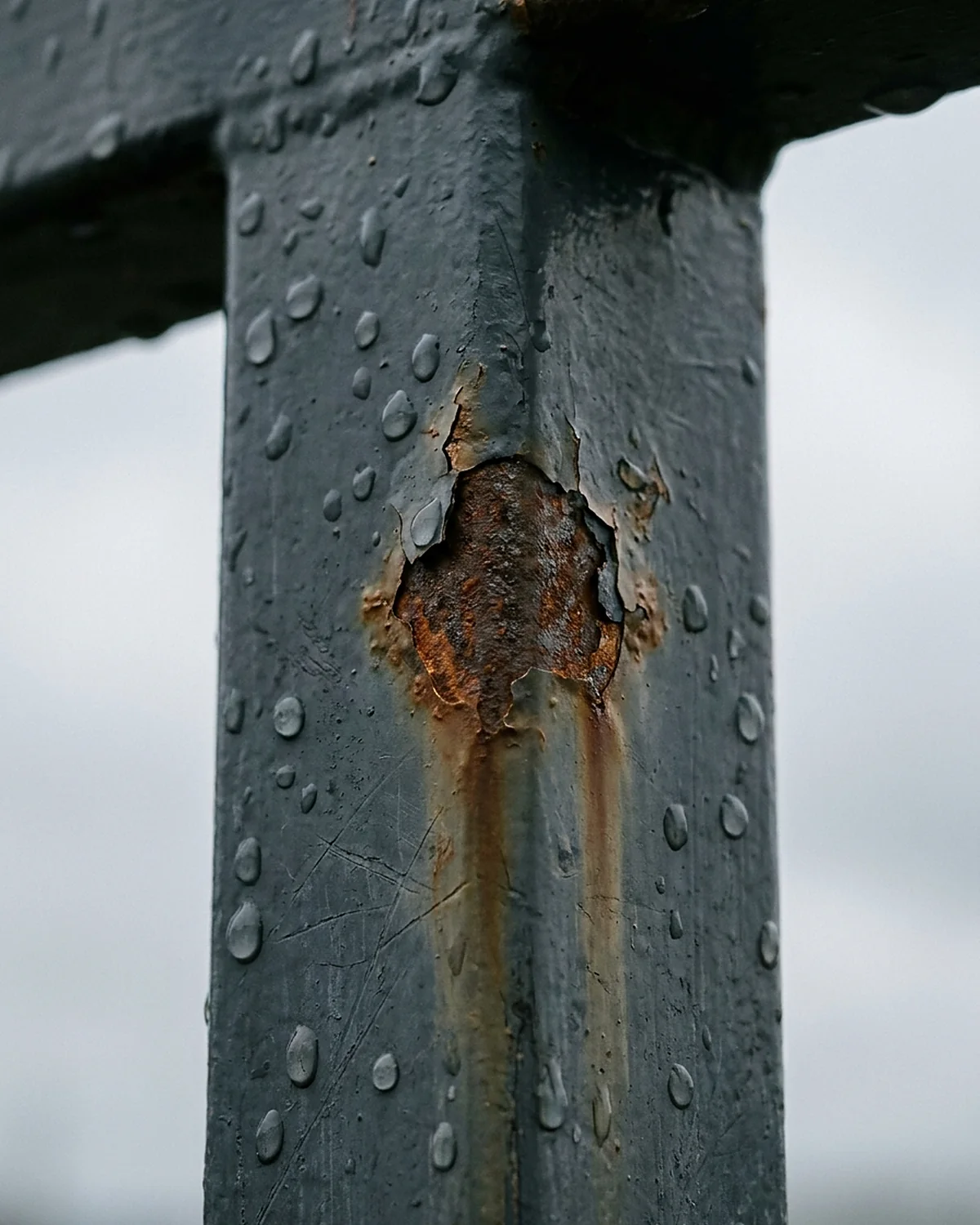
Iron ions hydrolyze and participate in subsequent reactions, changing local pH. They can migrate before precipitating, so the visible rust deposit need not sit exactly over the greatest metal loss. A runoff stain can mark where products traveled, not where a component became thinnest.
The cathode completes the transaction
In aerated near-neutral water, a common cathodic reaction is oxygen reduction:
O₂ + 2H₂O + 4e⁻ → 4OH⁻
This reaction consumes the electrons released by iron dissolution. Anodic and cathodic rates couple: sustained corrosion cannot accumulate electrons indefinitely in the metal. In acidic conditions, hydrogen-ion reduction or other cathodic processes may matter. Microorganisms and oxidizing species can alter local chemistry. One equation is not a universal environmental script.
Combine idealized half-reactions and it becomes tempting to draw iron ions meeting hydroxide instantly to make “rust.” Real corrosion proceeds through dissolved intermediates, hydrolysis, oxidation states, precipitation, dehydration and solid-state changes. Oxygen transport through water and porous deposits can limit the rate. Wet–dry cycling can repeatedly dissolve and transform phases.
The essential circuit has four elements: anodic reaction, cathodic reaction, electronic connection through metal and ionic connection through electrolyte. Break one effectively enough and corrosion slows.
One droplet can separate anode from cathode
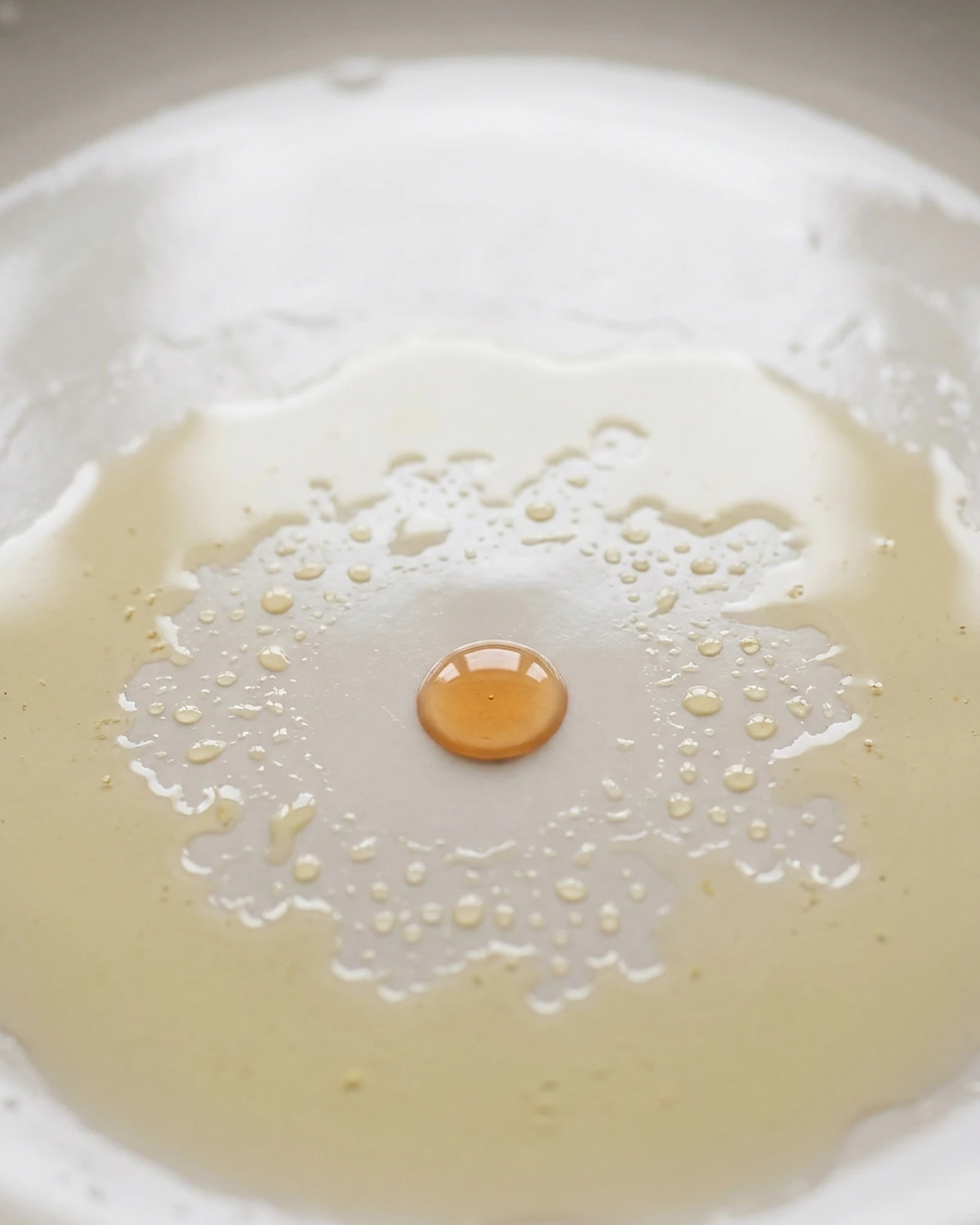
Under a stationary water droplet, oxygen often reaches the edge more readily than the center. This differential aeration can help establish oxygen-rich cathodic regions and oxygen-poor anodic regions. The exact distribution evolves with droplet thickness, evaporation, salts and surface condition, so the classroom ring diagram is a model rather than a permanent map.
Crevices create a more persistent transport difference. Within a narrow gap under a gasket, deposit or lap joint, oxygen can be depleted. Hydrolysis of dissolved metal ions can acidify the confined solution, and chloride can migrate inward to maintain charge balance. The local environment grows more aggressive than the bulk water outside.
This feedback explains why a component may look acceptable except at a joint. It also shows why “keep it dry” is incomplete advice: trapped moisture can persist where air circulation is poor, and intermittent condensation may be enough. Corrosion engineers ask how long a surface remains wet, not only whether it was once rained on.
Salt carries charge and changes films
Pure water conducts ions poorly compared with an electrolyte containing dissolved salts. Sodium chloride supplies mobile ions, lowering solution resistance and helping electrochemical current flow. Chloride can also penetrate or destabilize protective films on susceptible alloys and concentrate during evaporation.
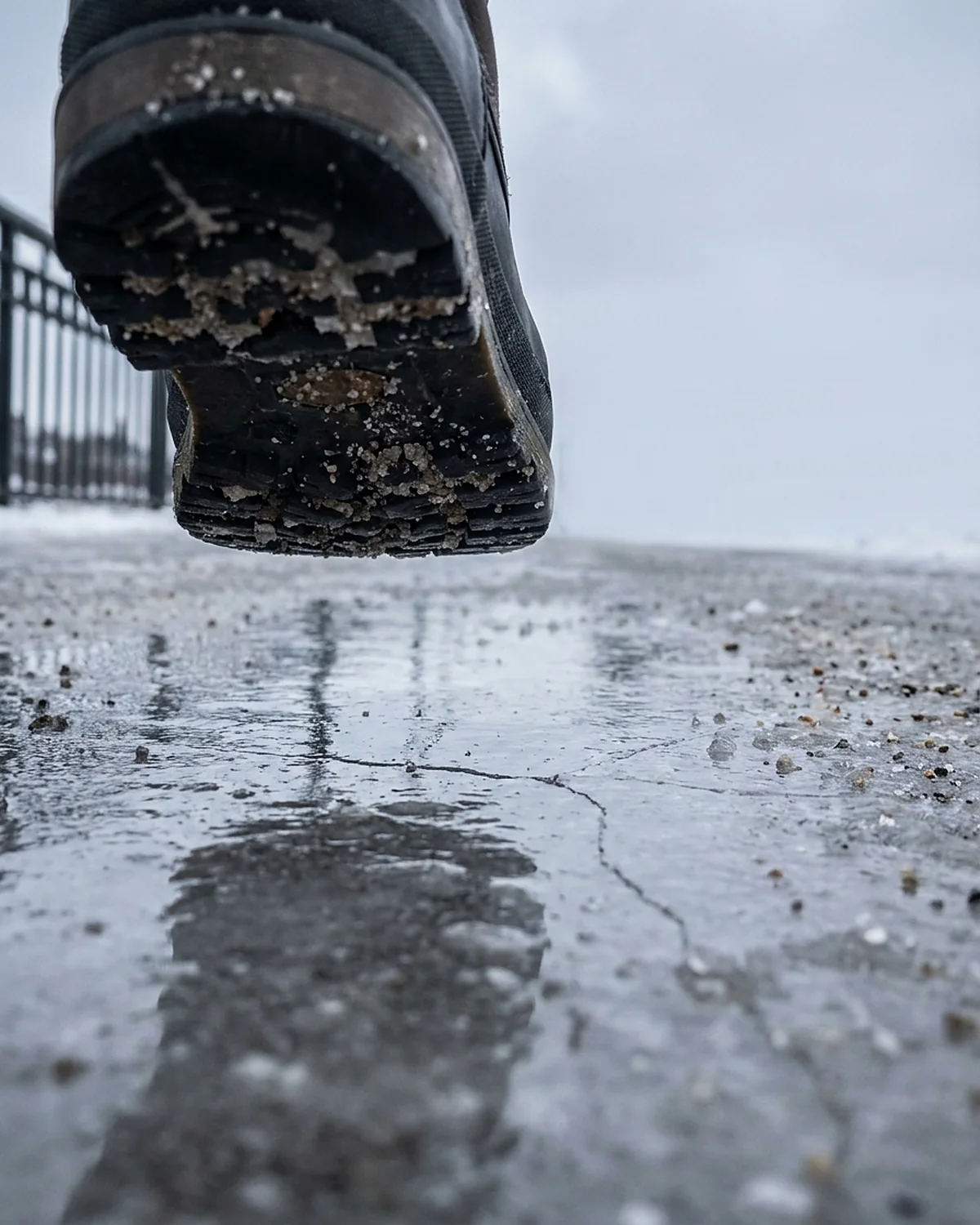
Salt is therefore an accelerator and environmental participant, not the oxidizing fuel in the simple sense. It can remain in solution or deposits and act through many wet–dry cycles. Road spray reaches seams; sea aerosols settle above splash zones; fingerprints leave chloride-bearing residues. Humidity later turns hygroscopic contamination into a thin conducting film.
More salt does not produce one linear corrosion rate forever. Oxygen solubility and transport, solution viscosity, deposit formation and drying all change with concentration. Different alloys and geometries respond differently. A laboratory salt-spray ranking cannot automatically predict years outdoors, because continuous salt fog and natural cyclic exposure create different transport and films.
A bounded calculation: small current, visible loss
Faraday’s law connects electric charge to the amount of material oxidized. Suppose an iron surface sustains an illustrative average corrosion current of 1.0 mA for one year, and assume iron dissolves entirely as Fe²⁺ with 100% current efficiency:
Q = It = 0.001 A × 31,536,000 s = 31,536 C
m = QM/(nF)
Using iron’s molar mass M = 55.845 g/mol, n = 2, and Faraday’s constant F = 96,485 C/mol:
m ≈ 31,536 × 55.845 / (2 × 96,485) ≈ 9.1 g
At iron density near 7.87 g/cm³, that is about 1.16 cm³ of metal. If loss were perfectly uniform across 10 cm², mean penetration would be about 1.16 mm.
This is not a service-life prediction. Real current changes with time; reactions may have different efficiencies; alloy density varies; corrosion localizes; and rust can remain attached or wash away. Its purpose is to show that a milliampere sustained for a year represents grams of transferred iron. An electrical rate becomes structural geometry only after area and localization are known.
Rust usually fails to seal the surface
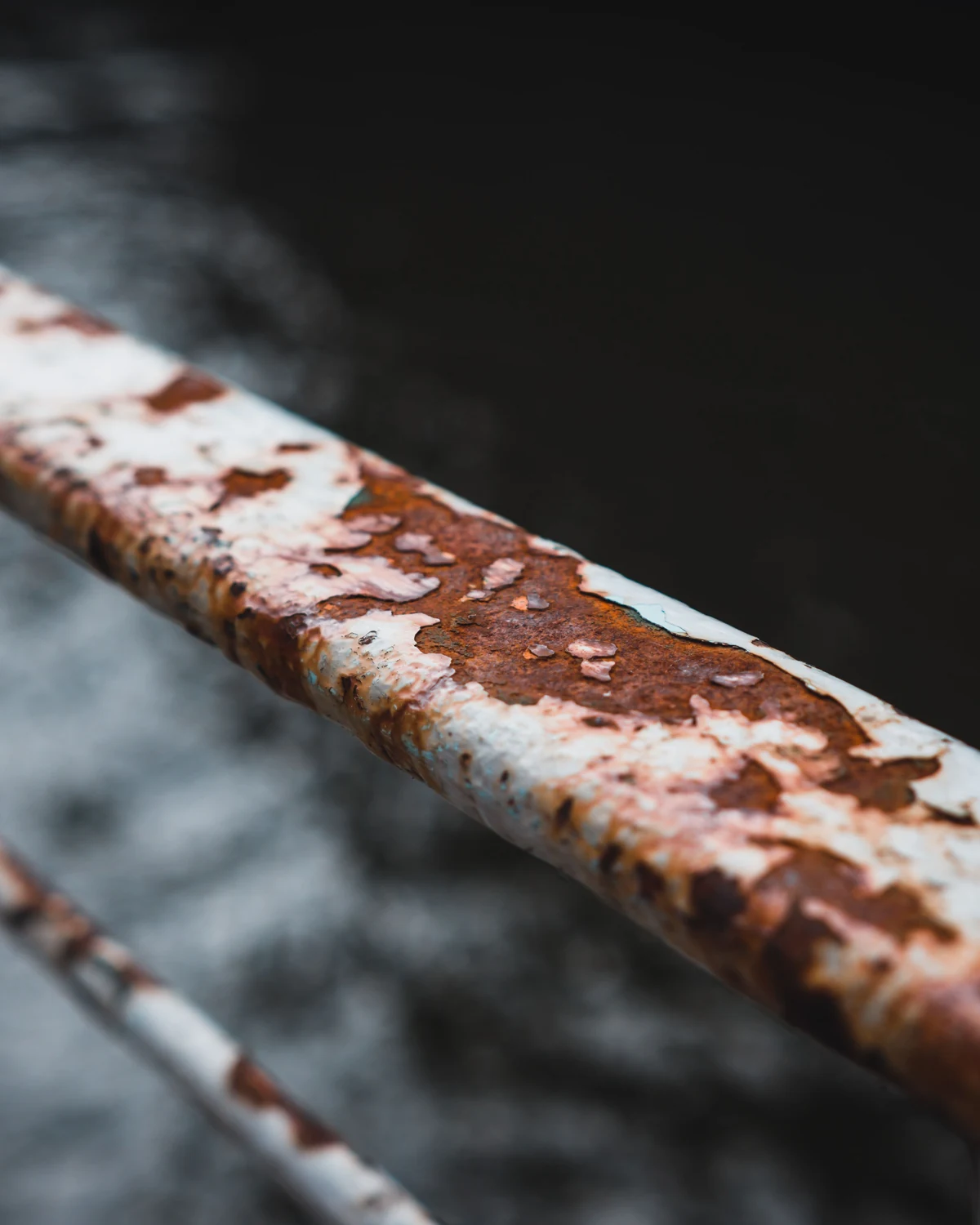
Some oxides form thin, adherent, slow-growing films that passivate a metal. Ordinary rust on carbon steel is often porous, cracked and poorly adherent. Water and oxygen can reach the metal through pores and defects, while expansion stresses loosen the scale. Rust can shelter salts and maintain differential environments.
The products occupy a different volume from the iron consumed. Expansion can lift paint, jam moving parts and, in reinforced concrete, generate stresses that crack the surrounding cover. A large rust mound may include oxygen, hydrogen and water from the environment; its volume does not equal a solid block of lost steel.
Weathering steels are designed to develop a more protective corrosion-product layer under suitable alternating wet and dry exposure. Persistent dampness, deicing salts, marine chlorides or sheltered details can prevent the intended patina from performing. “It is supposed to rust” is not permission to ignore environment or inspection.
Paint works only while it remains a system
A coating separates metal from water, oxygen and ions and may contain inhibitive pigments. Surface preparation is crucial: rust, oil, salts and weak scale beneath paint can undermine adhesion or create active cells. Edges, welds and bolt heads often receive thinner coverage and higher stress.
A scratch does not make every coating useless, but it creates a pathway whose importance depends on coating chemistry, adhesion, primer and environment. Water can travel beneath a poorly bonded film. Blistering may reflect osmotic processes, corrosion products or trapped contaminants. Painting visibly rusted infrastructure without assessment can hide rather than solve a problem.
Coating specifications define preparation, dry-film thickness, curing, inspection and repair. Consumer touch-up and industrial bridge protection are not interchangeable. Removing old coatings can expose lead or hazardous dust; abrasive blasting and chemical rust removers require controls. This article gives no unsafe restoration procedure.
Zinc protects by two different routes
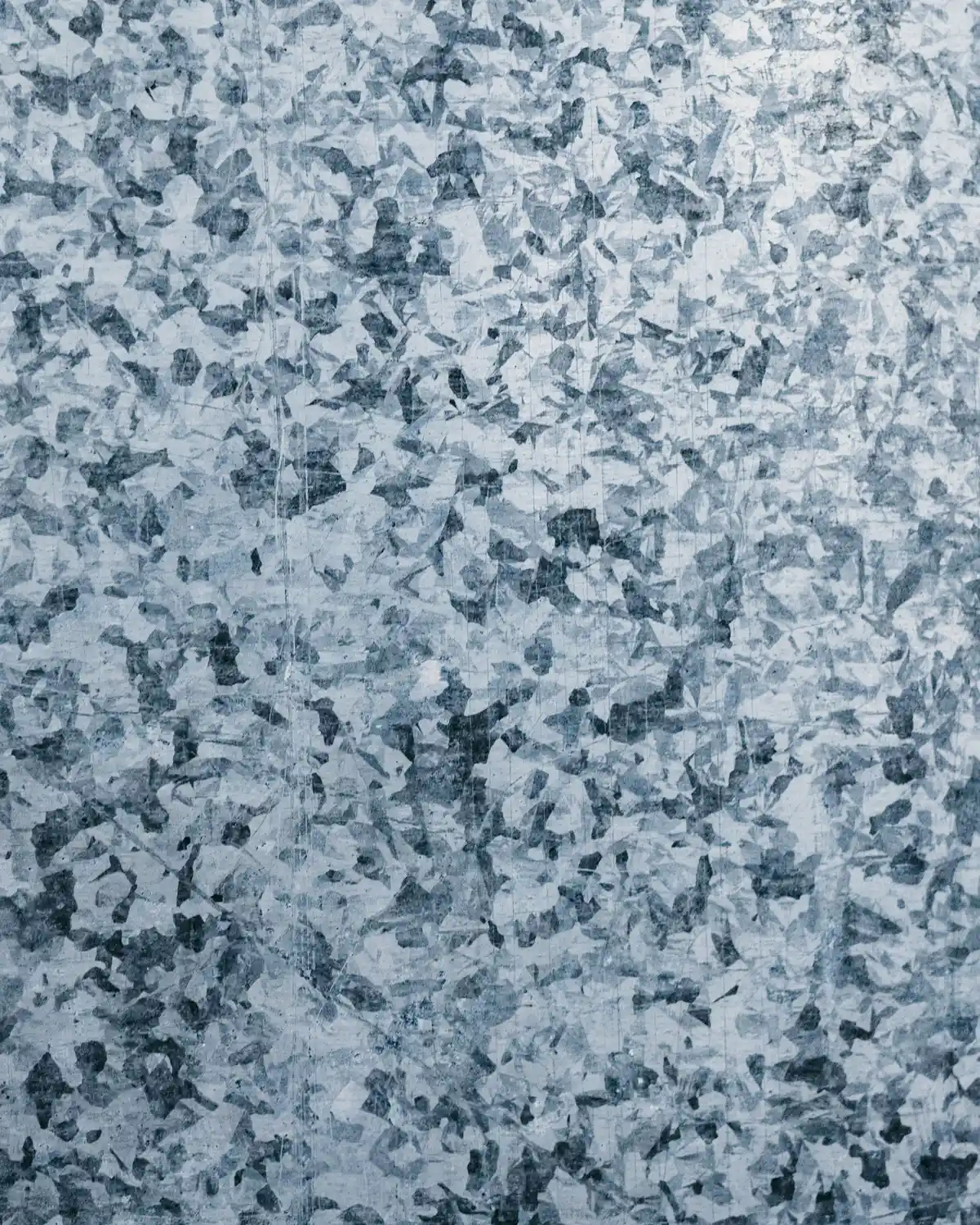
Galvanizing coats steel with zinc and zinc–iron alloy layers. The coating provides a physical barrier. Where a small defect exposes steel, zinc can also act anodically relative to iron in many environments, supplying protective current while it is consumed. This is sacrificial protection.
The phrase “zinc rusts instead” is directionally helpful but incomplete. Zinc forms its own corrosion products, some of which can be protective. The current distribution depends on exposed-area ratio, electrolyte conductivity, geometry and environment. A tiny zinc area coupled to a large bare steel area may be exhausted rapidly; a well-designed coating has a different balance.
Cathodic protection of buried or immersed structures can use sacrificial anodes or impressed current. Too little protection fails; excessive potential can damage coatings or create other problems for certain alloys and structures. Design and monitoring belong to qualified corrosion professionals. Attaching a random metal to a structure is not an experiment to recommend.
Stainless steel is protected, not stainless by magic
Chromium in stainless steel supports formation of a thin chromium-rich passive film that strongly slows dissolution in many environments. If damaged mechanically, the film can reform when chemistry permits. That self-repairing nanometer-scale barrier explains why the material can remain bright.
It does not make stainless steel immune. Chloride can promote localized breakdown and pitting. Crevices, heat-affected zones, sensitization, low oxygen and high temperature change performance. Stainless grades differ in chromium, nickel, molybdenum, nitrogen, carbon and microstructure. “Marine grade” is not a complete specification.
Aluminum and titanium also rely on passive oxides, with their own vulnerabilities. Comparing their thin protective films with porous iron rust reveals that oxidation itself is not synonymous with disastrous corrosion. The question is whether the reaction product isolates the substrate under the actual mechanical and chemical conditions.
Galvanic couples redistribute the attack
Connect dissimilar conductive materials in an electrolyte and their electrochemical potentials can drive galvanic corrosion. The more active member tends to become anodic, while the nobler member supports cathodic reaction. But a generic galvanic-series ranking applies only in the stated environment and surface condition.
Area ratio matters. A small anodic fastener coupled to a large cathodic sheet can face high dissolution current density. The reverse ratio may be less severe. Electrical isolation, sealants, compatible fasteners and drainage are design tools, but each must survive service.
Even nominally identical steel can develop galvanic differences through mill scale, weld metal, cold work or oxygen concentration. Dissimilar metals make the circuit easy to recognize; they are not required for it. Rusting an isolated nail in wet air already contains spatially separated electrochemical reactions.
Robert Hadfield changed steel by changing its alloy
Nineteenth-century metallurgy increasingly connected alloy composition and microstructure with performance. Robert Hadfield’s work on manganese steel demonstrated how dramatically alloying and heat treatment could alter a steel’s behavior. In the early twentieth century, researchers in several countries developed chromium-bearing steels that became known as stainless, with Harry Brearley often associated with one important British strand.
No single inventor “solved rust.” Stainless steels emerged through distributed experiments in weapons, cutlery, chemical equipment and high-temperature alloys. Electrochemists built theories of mixed potentials and passivity; civil and marine engineers learned from failures; standards organizations made tests and terminology more comparable.
The human thread is a change in target. Instead of merely cleaning corrosion after it appeared, engineers learned to design composition, microstructure, geometry and environment together. Prevention became a systems discipline—not a miracle coating applied at the end.
Corrosion tests accelerate conditions, not time itself
Mass-loss coupons are cleaned according to controlled procedures, weighed, exposed and weighed again. Electrochemical polarization methods estimate reaction behavior over shorter periods. Electrical-resistance probes track section loss. Microscopy and spectroscopy identify pits and products. Ultrasonic thickness measurements inspect remaining wall.
Each method sees something different. Removing corrosion products can also remove base metal if cleaning is too aggressive. Polarization can disturb the surface. A probe samples one location. Salt-spray tests provide reproducible harsh exposure but may rank coatings differently from cyclic outdoor weathering. Accelerated testing changes mechanisms if temperature, wetness or chemistry moves outside service reality.
Good corrosion reports specify alloy and heat treatment, surface preparation, electrolyte, temperature, aeration, exposure time, area, cleaning standard and replicate variation. A photograph of orange coverage supplies almost none of that information. Visual severity and penetration can diverge.
Rust color is not a structural assessment
Surface staining may be shallow and mostly cosmetic, or it may accompany deep localized loss hidden under scale. Conversely, a component can lose critical thickness inside a pipe or crevice while its visible exterior appears sound. Load path, residual thickness, cracks, geometry and material properties determine structural consequence.
Do not scrape, hammer, climb or load a suspect structure to “test” it. Vehicle brake lines, pressure vessels, electrical enclosures, ladders, balconies and load-bearing steel carry hazards beyond chemistry. Qualified inspection may use thickness measurements, access to concealed faces and engineering calculations.
The same boundary applies to household remedies. Acids may dissolve rust but can attack base metal, coatings and skin; mixing cleaners can create toxic gases. Electrolytic cleaning introduces electrical, hydrogen and chemical hazards. Mechanism knowledge does not authorize an improvised treatment.
Time and transport write the final pattern
Corrosion needs compatible half-reactions and paths, but its shape comes from transport. Oxygen must arrive; ions move through liquid; products diffuse or precipitate; heat changes rates; wetting and drying concentrate contaminants. Geometry controls retention. Microstructure supplies sites with different tendencies. Stress can open cracks or interact with environmental attack.
That is why two neighboring bolts age differently. One may drain and dry; one traps a chloride solution. One coating edge is thick; another was damaged during assembly. One fastener creates an unfavorable galvanic area ratio. The chemistry may share equations while the service histories diverge.
Rust is not iron simply getting old, and oxygen is not nibbling uniformly from the outside. A self-organized cell transfers charge and matter through a changing interface. Its products then modify the cell that created them.
The brown surface is the ending we can see. Beneath it lies the more important story: where atoms left, where electrons went, how ions returned, what blocked transport and how long the circuit remained wet. Corrosion control begins by drawing that circuit accurately—and safety begins by admitting that color alone cannot tell us what remains.
Frequently asked questions
Do all metals rust?
No. Rust refers to iron corrosion products. Other metals corrode and form oxides, sulfides, carbonates or other films with different properties.
Does rust require water?
Atmospheric rusting generally requires an electrolyte, often a thin film from rain, humidity or condensation. Completely dry oxygen reacts far more slowly at ordinary temperatures.
Why does salt accelerate rusting?
Salt increases ionic conductivity, can retain moisture and chloride can destabilize protective films. Its effect depends on concentration, wet–dry cycling, alloy and geometry.
Can rust protect iron?
Ordinary carbon-steel rust is often porous and nonprotective. Some weathering steels can form a more protective patina in suitable environments, but not under every exposure.
Why does galvanized steel resist rust?
Zinc provides a barrier and can corrode sacrificially to protect small exposed steel areas. Its performance depends on coating integrity, geometry and environment.
Can stainless steel rust?
Stainless steels can corrode when their passive film breaks down, especially in chloride-rich crevices or unsuitable temperatures. Grade and condition matter.
Does more visible rust mean more strength loss?
Not reliably. Deposits can be bulky while penetration is modest, or severe localized loss can hide beneath scale. Inspection must measure relevant remaining material.
Can rust simply be painted over?
Durable coating usually requires specified assessment and surface preparation. Painting over contamination or loose products may trap an active problem and can hide damage.
Sources & further reading
This explainer was prepared through desk research using the sources below; established findings are distinguished from open questions in the text. See our editorial methodology.
- ASTM International, ASTM G1-25 — Standard Practice for Preparing, Cleaning, and Evaluating Corrosion Test Specimens — current mass-loss measurement and cleaning controls.
- ASTM International, ASTM G31-21(2025) — Standard Guide for Laboratory Immersion Corrosion Testing of Metals — current controlled-exposure variables and reporting.
- ISO, ISO 8044:2024 Corrosion of metals and alloys — Vocabulary — current authoritative terminology boundary.
- AMPP, What Is Corrosion? — professional overview of electrochemical cells and control categories.
- Stratmann & Streckel, The investigation of the corrosion of metal surfaces, covered with thin electrolyte layers—a new experimental technique — atmospheric thin-film corrosion.
- Graedel & Frankenthal, Corrosion mechanisms for iron and low alloy steels exposed to the atmosphere, Journal of the Electrochemical Society — atmospheric rust chemistry and transport.
- Frankel, Pitting corrosion of metals: a review of the critical factors, Journal of the Electrochemical Society — passivity breakdown and localized corrosion.
- U.S. Federal Highway Administration, Corrosion of Steel in Concrete Structures — chloride transport, reinforcement corrosion and infrastructure consequences.
- American Galvanizers Association, Hot-Dip Galvanizing for Corrosion Resistance — barrier, cathodic and zinc-patina protection.
- NIST, CODATA Value: Faraday constant — constant used in the bounded mass-loss calculation.
Spotted an error? We correct verified mistakes promptly — email contact@flashscience.org.
Continue exploring