Science explained · Space
Why Does the Moon Always Show the Same Face?
How can the Moon rotate once every orbit yet seem not to turn at all?
Explore the sections in this article
The no-spin Moon would show every side
Imagine an arrow painted on the Moon and fixed toward a distant star. Move the Moon one quarter around Earth without rotating it. From Earth, a different lunar longitude now faces inward. After half an orbit, the original near side faces away. A truly nonrotating Moon would parade its entire circumference past us once per orbit.
Now rotate it one quarter-turn during that quarter-orbit, in the same sense as its revolution. The arrow keeps facing Earth. Four quarter-turns produce one full spin and one full orbit. A four-frame overhead diagram makes this clearer than a rotating globe animation with no fixed marker.
The rotation is slow. At the lunar equator, ground moves only a few metres per second relative to the spin axis. Slow is not zero.
Two months answer two different questions
Relative to distant stars, the Moon completes one orbit and one rotation in about 27.3217 days. That is the sidereal month. But Earth and Moon travel around the Sun during that interval. The Moon must move farther before the Sun–Earth–Moon geometry repeats from new moon to new moon. That synodic month is about 29.5306 days.
Phases belong to illumination geometry, not to tidal locking. Half the Moon is illuminated by the Sun at almost every ordinary moment; we see different fractions of that lit half. The far side receives sunlight and darkness in turn. Calling it the “dark side” confuses unseen from Earth with unlit by the Sun.
A solar day at one lunar location—sunrise to sunrise—lasts one synodic month, about 29.5 Earth days. A sidereal rotation is shorter because the direction to the Sun changes as the Moon orbits Earth and Earth orbits the Sun.
A bounded calculation: a slow but real spin
Use sidereal rotation period P = 27.321661 days and lunar mean radius R = 1.7374 × 10⁶ m. Convert time:
P ≈ 27.321661 × 86,400 s ≈ 2.3606 × 10⁶ s
Angular speed is:
ω = 2π/P ≈ 2.66 × 10⁻⁶ rad/s
An equatorial point’s rotational speed is:
v = ωR ≈ 4.62 m/s ≈ 16.6 km/h
The value is tiny beside Earth’s equatorial rotation speed, but it is measurable and exactly the order required for one turn per lunar orbit. The calculation treats the Moon as rotating uniformly about its mean axis; physical librations add small variations.
Gravity can exert a torque only through shape
If the Moon and Earth were perfect point masses, mutual gravity would guide their orbit but could not select a lunar face. Real bodies have size and deform. Earth’s gravity is slightly stronger on the Moon’s near side than its far side, creating a differential force—a tide—that stretches the Moon along approximately the Earth–Moon line.
Early after formation, the Moon was hotter, closer to Earth and likely rotating faster. The location of its tidal distortion could not adjust instantly as material turned through the Earth direction. Real rock has elasticity and dissipation. The distorted figure lagged or led exact alignment depending on spin state, so Earth’s unequal pull on that misaligned mass created a torque.
For an initially faster-spinning prograde Moon, the average tidal torque slowed the spin. Mechanical energy became heat inside deforming material. Angular momentum was exchanged between spin and orbit within the Earth–Moon system, while solar torques also matter over long histories. “Friction stopped the Moon” is inadequate: it did not stop, and the energy and angular momentum follow different bookkeeping.
Why the torque fades near synchronism
When one rotation matches one orbit on average, the same lunar longitude remains near Earth. The dominant tidal figure no longer sweeps rapidly through the Moon, greatly reducing that component of changing deformation and its secular spin torque.
The state is dynamically favoured, but not perfectly static. The lunar orbit is eccentric, so orbital angular speed varies while mean spin is nearly uniform. Earth’s direction oscillates in lunar longitude; tidal flexing and dissipation continue. Solar perturbations, inclination and the Moon’s internal structure add more terms.
“Locked” suggests a latch clicking shut. A resonance is better: coupled rotation and orbit settle into a repeating relation. Small departures can librate around the preferred orientation rather than circulate freely.
A permanent figure helps hold the orientation
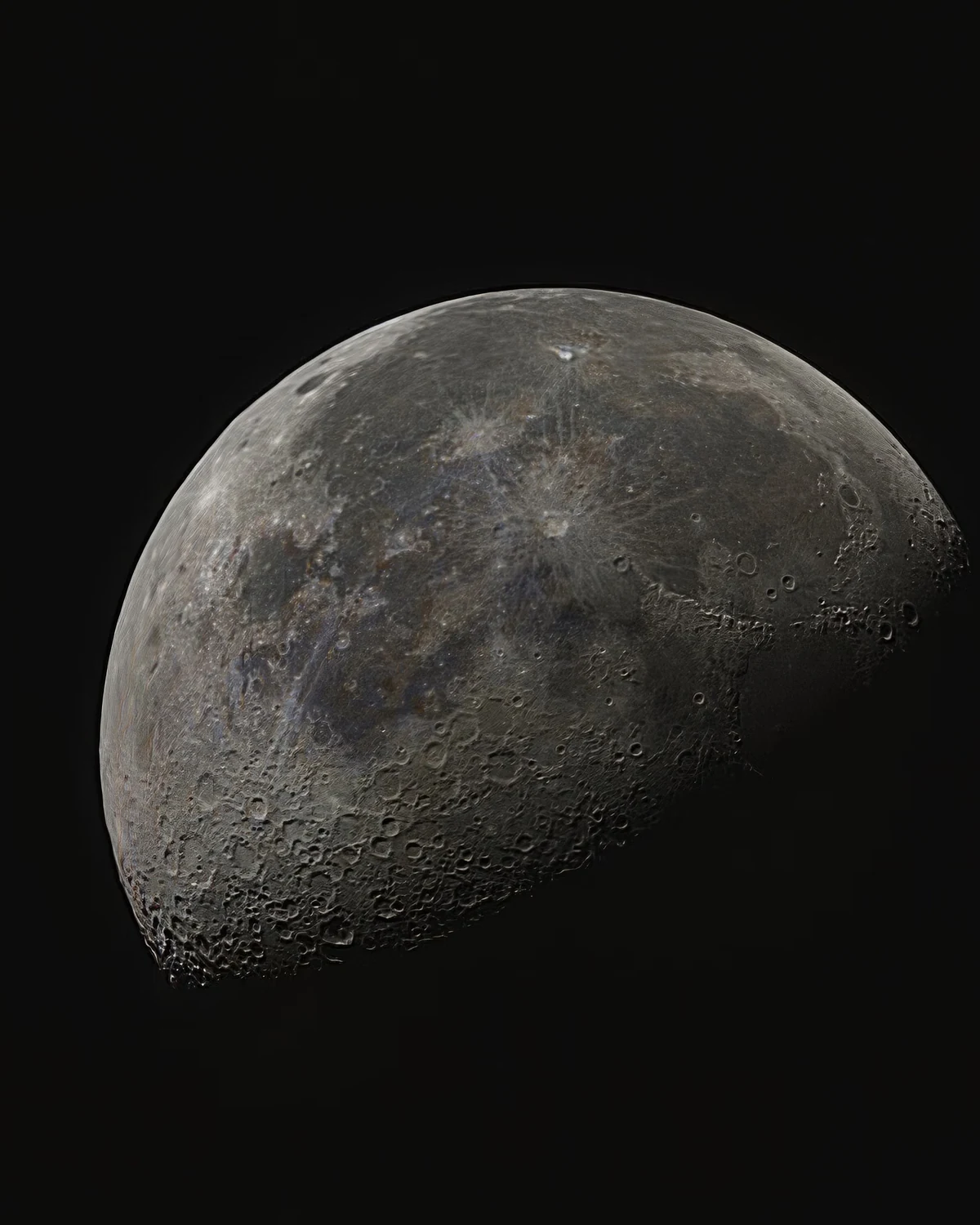
The Moon is not a perfectly symmetric sphere. Its moments of inertia differ slightly; a triaxial permanent figure has a long axis that preferentially points toward Earth. Earth’s torque on this figure supports the 1:1 resonance and produces physical librations.
Tidal dissipation explains evolution toward resonance; triaxiality helps describe capture and present oscillations. The exact history depends on the early Moon’s viscosity, temperature, orbital eccentricity, distance and impact evolution—properties that are reconstructed rather than directly witnessed.
Other worlds occupy different spin–orbit resonances. Mercury rotates three times for every two orbits around the Sun, aided by its eccentric orbit and permanent figure. Many major moons are synchronously rotating with their planets. “Tides always produce 1:1 locking” is thus too broad; outcome depends on dynamics and material response.
Libration lets Earth peek around the edges
Optical libration in longitude arises mainly because the Moon’s orbital speed varies along its ellipse while its spin rate is nearly steady. Near perigee it moves faster in orbit; near apogee, slower. The Earth-facing longitude therefore rocks east and west.
Libration in latitude occurs because the lunar equator is tilted relative to its orbital plane, letting observers alternately see slightly beyond north and south limbs. Diurnal libration comes from an observer’s changing viewpoint as Earth rotates: from moonrise to moonset, the observer shifts by nearly an Earth diameter.
Physical librations are small genuine variations in the Moon’s rotation, measured by observations and lunar laser ranging. They reveal moments of inertia and clues to the core. Libration is subtle. Any animation in which it looks obvious has exaggerated it, and the real Moon does not visibly wobble.
The face is not centred exactly on Earth’s centre at every instant
Synchronous rotation matches mean rates. In an eccentric, inclined, perturbed orbit, the instantaneous Earth direction changes. The Moon also orbits the Earth–Moon barycentre while Earth does the same; the barycentre lies inside Earth but not at its centre.
From the lunar near side, Earth remains in roughly the same part of the sky, moving in a small pattern due to libration rather than rising and setting as the Sun does. Near the limbs, Earth may sometimes dip below the local horizon. “Earth hangs perfectly fixed over every near-side location” is only an idealization.
How we learned there was another hemisphere
Telescopic observers mapped libration and realized that more than half the surface becomes visible over time, but the central far side remained unseen. In 1959, the Soviet Luna 3 spacecraft photographed it. The images revealed terrain unlike the familiar near side, with far fewer large dark maria.
Later orbiters mapped both hemispheres in detail. The geological asymmetry is not what causes tidal locking; synchronous rotation selects orientation through mass distribution and dynamics, while crustal thickness, impacts, volcanism and thermal evolution shape the visible differences. A simple claim that Earth “shielded” the near side from impacts is not supported—impactors can approach both hemispheres.
Apollo astronauts and robotic missions left retroreflectors. Lunar laser ranging times pulses from Earth observatories to these arrays with extraordinary precision. Decades of measurements constrain the Moon’s orbit, physical librations, tidal response and recession.
The Moon is receding, but not because its own spin just stopped
Earth rotates faster than the Moon orbits. Lunar tides raised in Earth—especially dissipative ocean tides, plus solid-Earth effects—produce a torque that slows Earth’s rotation and transfers angular momentum to the lunar orbit. The Moon’s average distance currently increases by about 3.8 centimetres per year as measured by laser ranging.
That present rate should not be projected unchanged billions of years backward or forward. Ocean basins, continental arrangement, sea level, Earth’s rotation and lunar distance change tidal dissipation. Geological proxies and dynamical models are needed for history.
The process acting on Earth today is related to, but not identical with, the early tidal braking of lunar spin. Blending the two can make it sound as if the Moon must keep slowing below synchronous rotation as it recedes. Resonant dynamics adjust amid the evolving orbit.
Measuring rotation without watching a painted dot
Astronomers track craters and limb profiles against stars, analyse image sequences and measure laser ranges. Spacecraft radio tracking and gravity mapping constrain mass distribution. Seismometers from Apollo and modern geophysical models inform the interior response that determines tidal dissipation.
Rotation models include forced librations from known orbital terms and free librations that depend on initial conditions and damping. Parameters are estimated with covariances; different interior structures can reproduce some measurements. A clean classroom bulge cannot reveal the Moon’s precise tidal quality factor or ancient locking timescale.
What is firm and what remains reconstructed
It is directly established that the Moon rotates synchronously on average, librates, has a nonuniform gravity field and is receding today. Tidal torque and dissipation provide the accepted physical framework for spin evolution and resonance capture.
The exact early path is less certain. The Moon’s formation state, initial distance and spin, magma-ocean duration, ancient eccentricity, impact changes and frequency-dependent dissipation are model dependent. Estimates of when locking occurred depend on those inputs. “It took exactly X years” should not survive specialist review unless tied to a named model.
The apparent stillness is coordinated motion
From Earth, the lunar maria return night after night in familiar arrangement. That visual constancy is built from motion: one spin per orbit, small librations around resonance, orbital precession, and the shared journey around the Sun.
The face remains because the Moon turns at exactly the average pace needed to compensate for its changing orbital position. Tides did not freeze it. They converted a formerly different spin into a repeating relationship, while a slightly asymmetric Moon and Earth’s torque help maintain that relationship. What looks like stillness is celestial choreography.
Energy can dissipate while angular momentum moves
Tidal evolution is often described as “friction removes energy,” which is true but incomplete. Internal deformation converts ordered mechanical energy into heat. Total angular momentum of an isolated two-body system remains conserved, yet it can shift between each body’s spin and the orbit. External solar torque and mass loss make the real system more complicated over very long intervals.
This distinction explains why slowing Earth’s rotation can accompany an expanding lunar orbit. The Moon gains orbital angular momentum while the system loses mechanical energy as heat. A higher orbit has greater orbital energy—less negative in the bound convention—so energy bookkeeping includes the much larger decrease in Earth’s rotational energy.
For the early Moon’s own spin-down, the direction of transfer depended on its rotation relative to orbital motion. If a satellite spins faster than synchronous in the prograde sense, the average torque generally brakes it; below synchronous, the sign can reverse. Eccentricity and frequency-dependent material response complicate that sentence, which is why a single permanently offset bulge is a teaching model, not a literal fossil shape.
Resonance capture is a probability problem in general
As tidal torque changes a body’s spin, it can pass through commensurabilities between spin and orbital rates. A permanent triaxial figure creates restoring torques around these resonances. Capture likelihood depends on eccentricity, triaxiality, rate of spin evolution and dissipation model.
The Moon occupies 1:1. Mercury’s 3:2 state warns against assuming synchronism is inevitable for every eccentric world. Some small irregular moons rotate chaotically, while close binary bodies can become mutually locked, each keeping one face toward the other. Pluto and Charon are a familiar example of that double synchronism.
For exoplanets, “tidally locked” is often predicted from models rather than watched over a full resolved rotation. Atmospheres, oceans, companions and eccentricity affect evolution. The Moon supplies an accessible case, not a universal timescale formula.
A tabletop demonstration must keep the distant reference
The chair-and-ball demonstration fails if the person carrying the ball unconsciously turns their own body and calls that the ball’s frame. Put a sticker on the ball, mark north, and place a second marker across the room to represent distant stars. Photograph at four quarter-orbits from above.
In the synchronous run, the sticker stays chairward and points successively in four different distant-space directions: proof of one spin. In the no-spin run, the sticker keeps pointing to the room marker while different sides face the chair. A lamp can then represent the Sun, but it should sit far enough away that its rays are approximately parallel.
Do not use the lamp to explain tidal locking itself. Illumination produces phases, whereas Earth’s differential gravity and lunar material response drive tidal spin evolution. Combining chair, lamp and bulge in one unlabeled animation invites the false idea that sunlight locks the Moon.
Near side and far side are geographical, not permanent lighting zones
Except during eclipses, the Sun illuminates approximately one lunar hemisphere. At new moon, the far side is mostly sunlit while the near side is mostly dark; at full moon, the reverse is true. Sunrise migrates across lunar longitude over the synodic month.
Near-side and far-side temperatures vary enormously through their long day and night. Local topography and permanently shadowed polar craters create exceptions to a simple hemisphere picture. Some polar depressions receive no direct sunlight because the Moon’s axial tilt is small, not because they lie on the far side.
Communications provide a practical consequence. A lander on the central far side lacks direct line of sight to Earth and generally needs a relay satellite, while sunlight availability follows local time and terrain. “Dark side mission” is therefore doubly imprecise: it confuses radio geometry with lighting.
Frequently asked questions
Does the Moon rotate?
Yes. It rotates once relative to distant stars in the same time it completes one orbit around Earth.
What would we see if the Moon did not rotate?
Different lunar longitudes would face Earth throughout each orbit, eventually revealing every side.
Is the far side always dark?
No. It experiences daylight and night. “Far side” means the hemisphere facing mostly away from Earth.
Are the rotation and phase cycles both 27.3 days?
No. The sidereal spin/orbit period is about 27.3 days; phase-to-phase synodic month is about 29.5 days.
Do we see exactly 50 percent of the Moon?
At one instant, roughly half; libration lets us see about 59 percent over time.
Did Earth’s gravity simply stop the Moon?
No. Tidal torque changed its spin until it entered a 1:1 resonance; it still rotates.
Is tidal locking permanent?
It is a stable long-lived state, but real librations, perturbations and very slow system evolution continue.
Is the Moon moving away from Earth?
Yes, currently about 3.8 cm per year on average, but that modern rate is not constant across geological time.
Sources & further reading
This explainer was prepared through desk research using the sources below; established findings are distinguished from open questions in the text. See our editorial methodology.
- NASA Science, Top Moon Questions — rotation, 27.3-day orbit and 29.5-day phase interval.
- NASA Science, Tidal Locking — deformation, dissipation, synchronous state and lunar recession.
- NASA Science, Moon Facts — radius, distance, synchronous rotation and far-side terminology.
- NASA Science, Moon Viewing Tips — optical libration and observing context.
- JPL Solar System Dynamics, Planetary Satellite Physical Parameters — lunar radius and rotation/reference data.
- Williams, Turyshev & Boggs, Lunar Laser Ranging Tests of the Equivalence Principle, Classical and Quantum Gravity (2012) — LLR precision and dynamical constraints.
- Dickey et al., Lunar Laser Ranging: A Continuing Legacy of the Apollo Program, Science (1994) — recession, libration and lunar geophysics.
- Murray & Dermott, Solar System Dynamics (Cambridge, 1999) — tides, spin–orbit resonances, libration and capture.
- Garrick-Bethell et al., Evidence for a Past High-Eccentricity Lunar Orbit, Science (2006) — permanent figure and early orbital-history constraints.
- ESA, Moon Holds Key to Improving Satellite Views of Earth — libration exposes more than one exact hemisphere.
Spotted an error? We correct verified mistakes promptly — email contact@flashscience.org.
Continue exploring