Science explained · Life & Chemistry
How Do Geckos Walk on Walls?
How can a dry toe support a climbing animal, release in milliseconds and keep working after repeated steps without glue or suction?
Explore the sections in this article
No glue is secreted onto the wall
Adhesives such as pressure-sensitive tape use a compliant polymer that flows into surface texture and resists separation. Gecko setae are made from beta-keratin-related structural proteins and do not leave a wet adhesive film in normal dry locomotion. The feet may pick up particles and interact with trace surface films, but secretion is not the primary mechanism in the classic system.
Nor are the pads soft cups held by lower air pressure. Individual setae and isolated arrays can generate adhesive force without a sealed chamber. Adhesion works in vacuum in appropriately designed tests, contradicting suction as the general explanation. Tiny claws can help on rough substrates, but claws do not explain attachment to smooth glass.
The distinction matters for imagery. A toe pad is not a rubber plunger, and each seta is not a grappling hook inserted into microscopic holes. The endings approach the outermost surface closely enough for short-range physical attraction and distribute force across many contacts.
Van der Waals force is weak until repeated at close range
Atoms and molecules have fluctuating and induced electric dipoles. Their correlated fluctuations create attractive dispersion interactions, part of the family called van der Waals forces. Each interaction is small and drops rapidly with distance. Across a large real contact area at nanometre-scale separation, however, the sum can be substantial.
Experiments measured force from single gecko setae and tested them against surfaces with different chemistries. Adhesion correlated better with predictions from intermolecular contact than with capillary or electrostatic alternatives. The result did not mean one seta forms a permanent "van der Waals bond." It means distributed, reversible surface forces dominate under the tested dry conditions.
Close approach is the challenge. A nominally smooth wall contains roughness across scales. A rigid flat plate would touch only high points. Branched, slender setae divide contact so endings can conform locally without requiring the whole toe to deform into every valley.
Hierarchy makes compliance without a puddle
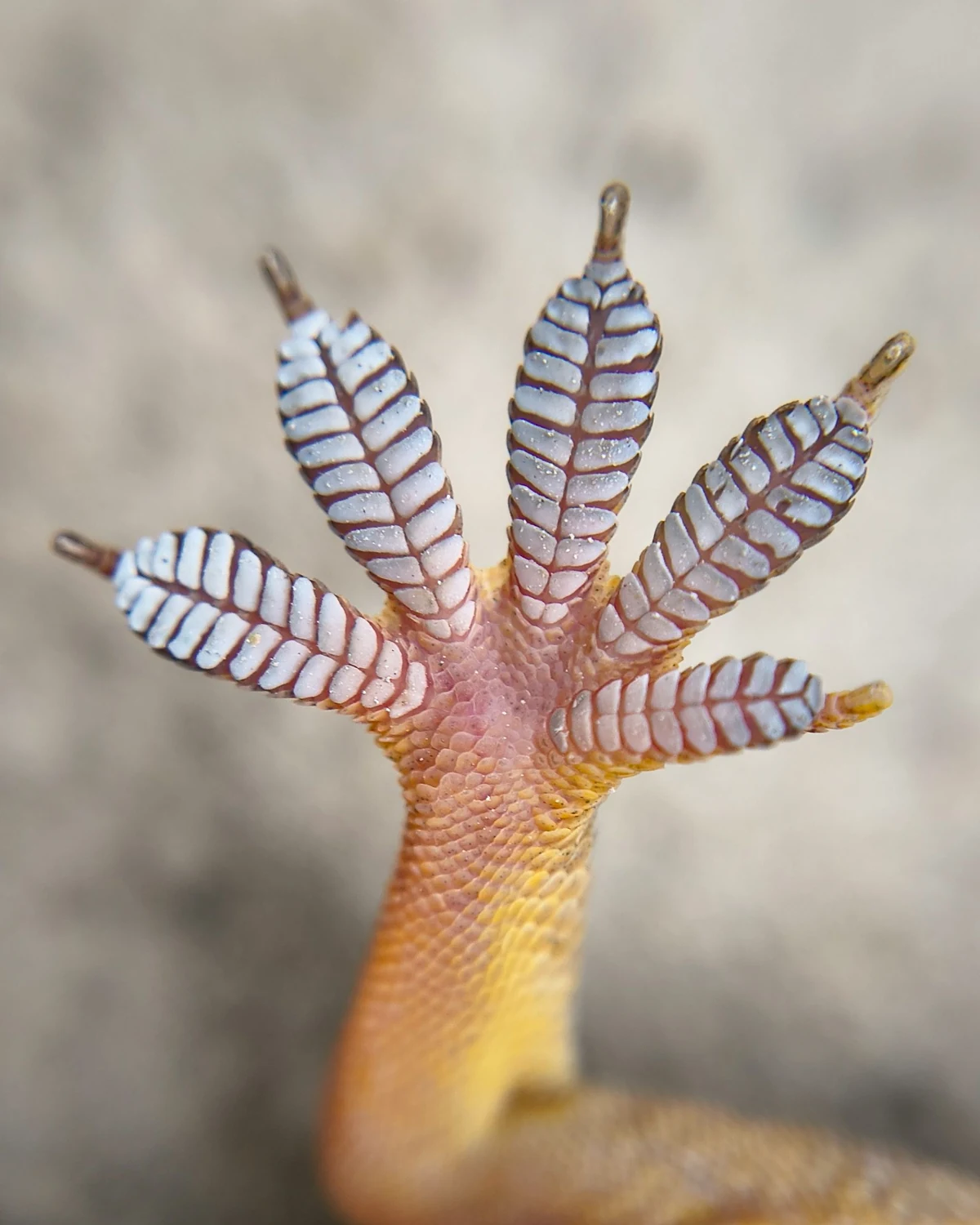
Lamellae allow the toe to wrap a surface at millimetre scale. Setae bend at micrometre scale. Their branches and spatular endings find still smaller areas of contact. This hierarchical compliance increases the fraction of apparent pad area that becomes intimate contact while limiting the amount of material that must deform.
The structures are angled rather than standing as an isotropic brush. Orientation gives the array different behavior depending on loading direction. Pulling or dragging the toe in a preferred proximal direction bends setae and recruits spatulae. Reversing shear or raising the angle reduces contact and promotes detachment.
"Millions of hairs" is a useful scale impression, not a fixed anatomy count. Counts and dimensions vary among species, toes, lamellae and measurement methods. A technical plate must cite the exact specimen. Generated forests of identical hairs can accidentally imply uniformity and false dimensions.
A seta is a directional adhesive spring
Kellar Autumn and colleagues showed that a single seta can carry far more force than its share of a gecko's body weight if all setae were equally engaged. Yet a standing animal does not recruit every ending at its maximum. Contact is uneven, safety factors vary and locomotion requires controlled release.
Single-seta experiments revealed an attachment sequence: preload brings the structure against a surface, then a small shear displacement aligns and engages it. Adhesive force depends on seta angle. Past a critical orientation or with reversed loading, attachment falls sharply. This property is called directional adhesion.
The array therefore behaves less like uniformly sticky tape and more like a field of microscopic levers with a preferred loading path. Muscles and tendons position digits; compliant pads distribute contact; setal geometry translates gross motion into nanoscale engagement. The animal controls a passive surface interaction through active movement.
Peeling solves the release problem
Pull a wide strip of tape straight away and much of its area resists together. Peel from an edge and a narrow front advances, breaking contacts sequentially. Geckos use digital hyperextension and toe peeling so detachment propagates across the pad rather than demanding simultaneous separation of every spatula.
High-speed studies show toes attach and detach rapidly during running. Distal portions can peel while the leg continues its stride. The exact kinematics differ by species and speed; "geckos curl their toes backward" is a simplification of three-dimensional joint motion and pad engagement.
Peeling also limits wasted work. Reversible weak interactions are advantageous because they do not require chemical reaction to undo. A small change in geometry switches the resultant force. Adhesion that could not be released would be a trap, not a locomotor system.
A bounded calculation: area makes force comparisons honest
Take a 50-gram tokay gecko as an illustrative animal. Its weight near Earth's surface is:
W = mg = 0.050 kg x 9.81 m/s^2 = 0.49 N
Suppose two feet share that static load equally. Each needs a vertical resultant of about 0.245 N, before any dynamic or safety factor. If the effectively engaged adhesive area on each foot were 100 mm^2 - an explicit hypothetical, not a measured universal contact - the average required stress would be:
0.245 N / 100 mm^2 = 0.00245 N/mm^2 = 2.45 kPa
That average is small compared with many reported local setal-array capacities. The difference is expected: not all apparent area makes contact, force is nonuniform, shear and body posture contribute, and locomotion needs reserve. The example does not predict maximum load or justify attaching objects to animals. It shows why spectacular single-seta extrapolations should not be mistaken for ordinary whole-foot stress.
Surface roughness creates a scale-matching problem
On molecularly smooth glass, many spatular endings can approach closely. On a mildly rough surface, compliance lets them follow contours. If asperities are too large or too sharp relative to the hierarchy, contact area falls. Claws may then contribute if they can interlock with features.
Roughness cannot be described by one number alone. Feature height, spacing and slope at several scales matter. A surface that looks smooth to a finger may be challenging at seta scale; a visibly rough bark surface may offer both setal patches and claw holds. Laboratory sandpapers do not reproduce every natural substrate.
Material chemistry matters through surface energy and contamination, but the system adheres to many hydrophilic and hydrophobic materials. Claims of "works on anything" ignore low-surface-energy coatings, loose particles, wet interfaces and geometries the foot cannot conform to.
Water changes the interface in more than one way
Humidity can soften keratinous setae and alter their compliance, sometimes increasing measured adhesion in controlled tests. At high humidity or on wet surfaces, water can also introduce capillary effects, screen close contact or cause slipping. Results depend on whether the toe, substrate or surrounding air is wet, and on surface chemistry.
Some pad-bearing geckos adhere poorly to glass submerged in water, while performance on hydrophobic surfaces can differ. Aquatic or wet-habitat taxa may have adaptations not represented by tokay geckos. "Gecko tape works underwater" is therefore not a consequence of van der Waals attraction alone.
Temperature and repeated cycling also influence tissue and locomotion. Researchers condition animals and surfaces, report humidity and clean substrates. A viral clip in a bathroom cannot identify which interfacial force dominated.
Dirt tests the difference between contact and glue
Particles block spatula-surface contact, so contamination initially reduces adhesion. Yet gecko feet can recover performance over repeated steps. In self-cleaning experiments, particles transferred preferentially from setae to a clean substrate because particle-substrate attraction could exceed particle-seta retention under stepping geometry.
This is passive self-cleaning, not a guarantee that every contaminant falls away. Oils, sticky residues, very small particles or rough surfaces can persist. Geckos also groom, adding behavior to material recovery. A self-cleaning synthetic adhesive must reproduce both contact mechanics and particle-release conditions.
The lotus-leaf analogy is misleading. Lotus leaves shed water and dirt through low wettability and surface texture; gecko setae recover through dry contact cycles and differential adhesion. Both are hierarchical surfaces, but their mechanisms and goals differ.
Feet work inside a whole-body force system
A gecko on a vertical wall must balance gravity and prevent pitching away from the surface. Front and hind limbs can generate opposing shear forces, producing a stable force couple. Tail contact may help prevent falls or control body rotation in some situations. Body posture changes how much adhesive and frictional force each foot needs.
During running, inertia joins gravity. Feet attach for part of a stride, transmit force, then detach. The nervous system coordinates placement, and sensors likely provide feedback about load and slip. Adhesive capacity measured with a stationary isolated toe overstates what is continuously available during fast locomotion.
Friction and adhesion are coupled. Shear can increase real contact and generate normal adhesive force; the system is often described as frictional adhesion. A diagram with only downward weight and upward "stickiness" misses the opposing fore-aft forces that stabilize the body.
Evolution repeated the solution with variations
Adhesive toe pads have originated multiple times within geckos and have also been lost. Similar ecological demands produced convergent hierarchies, but pad shape, setal branching and deployment differ. Anoles, insects and tree frogs use other adhesive systems with their own materials and often fluids.
Comparative research links setal dimensions and pad area with body size and habitat, while finding tradeoffs. Larger animals need more adhesive area or altered morphology, but available toe area and locomotor demands constrain scaling. Fossil geckos and phylogenies help reconstruct when pad features appeared.
Evolution did not optimize adhesion alone. A ground-dwelling gecko may benefit from reduced pad structures; debris-prone habitats alter performance; claws and digits serve other locomotor roles. Losing a pad can be adaptive rather than degeneration.
The human thread runs from microscope to climbing robot
Naturalists could see lamellae, but electron microscopy revealed forests of setae and branching endings. In 2000, single-seta force measurements quantified their extraordinary directional response. Surface-chemistry tests soon strengthened the case for van der Waals-dominated adhesion. These experiments replaced competing suction, glue and electrostatic stories with testable mechanics.
Engineers then made synthetic fibrillar adhesives. Some use polymers patterned into microscopic pillars or wedges; others combine rigid and soft layers. Robots can climb glass with controllable dry adhesives. Yet fabrication defects, dust, roughness, wear and large-area load sharing remain difficult. A synthetic "gecko-inspired" surface may copy directionality without copying biological materials or exact geometry.
Applications need honest specifications: substrate, preload, shear, peel force, cycle life, humidity and contamination. A demonstration lifting smooth glass does not certify wall-climbing rescue equipment or medical skin use.
How researchers measure an invisible contact
A micromanipulator can press and drag one seta against a calibrated sensor while controlling angle. Atomic-force or scanning-electron microscopy maps structure, though vacuum and coatings can alter samples. Whole-animal force plates and high-speed video connect microscopic capacity to movement. Interference methods can estimate real contact area through transparent surfaces.
Measurements must state whether the sample is live tissue, shed skin, isolated setae or synthetic arrays. Preload and shear history strongly affect results. Maximum force, work of detachment and repeated-cycle performance answer different questions. Ethical protocols minimize handling and avoid inducing falls.
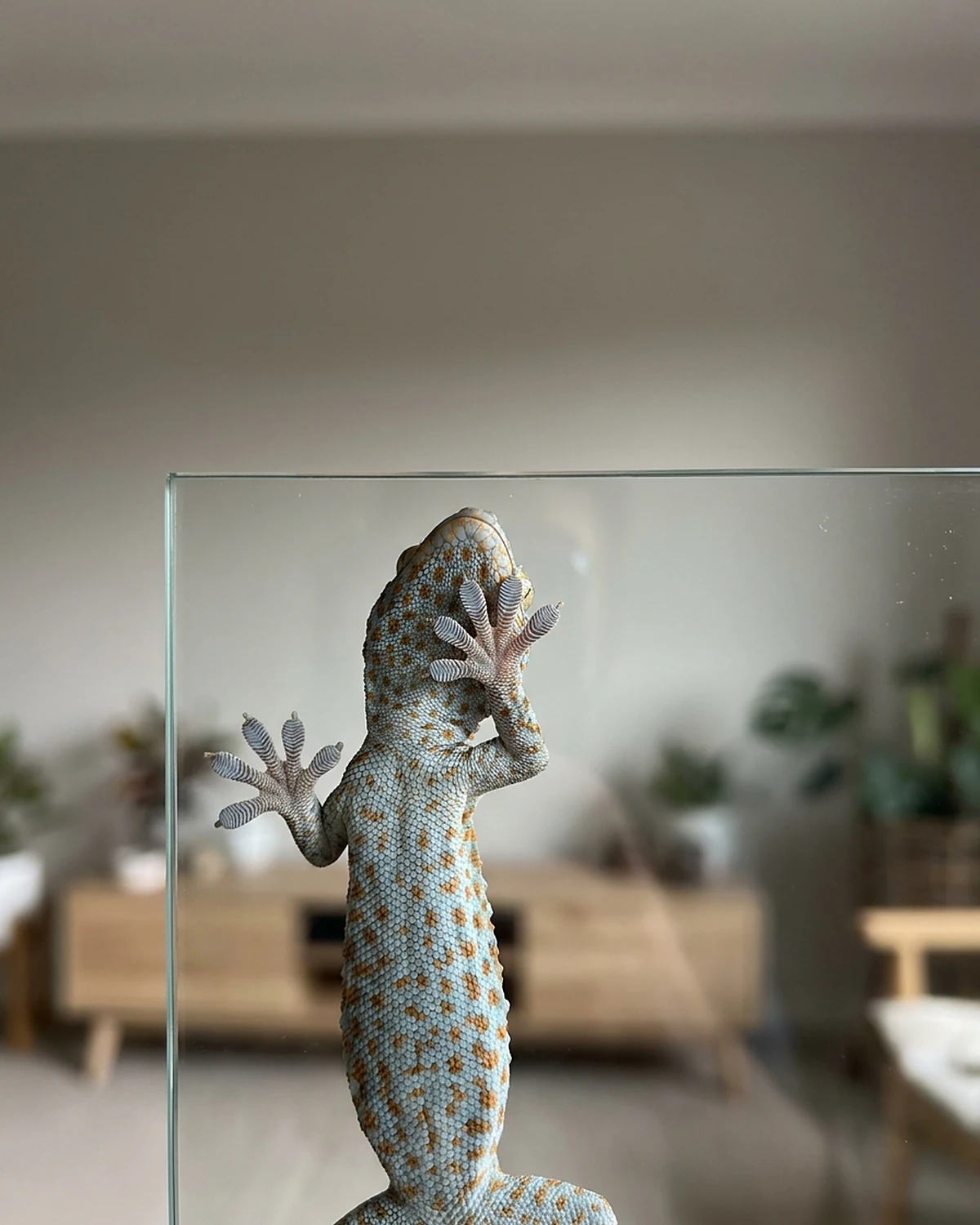
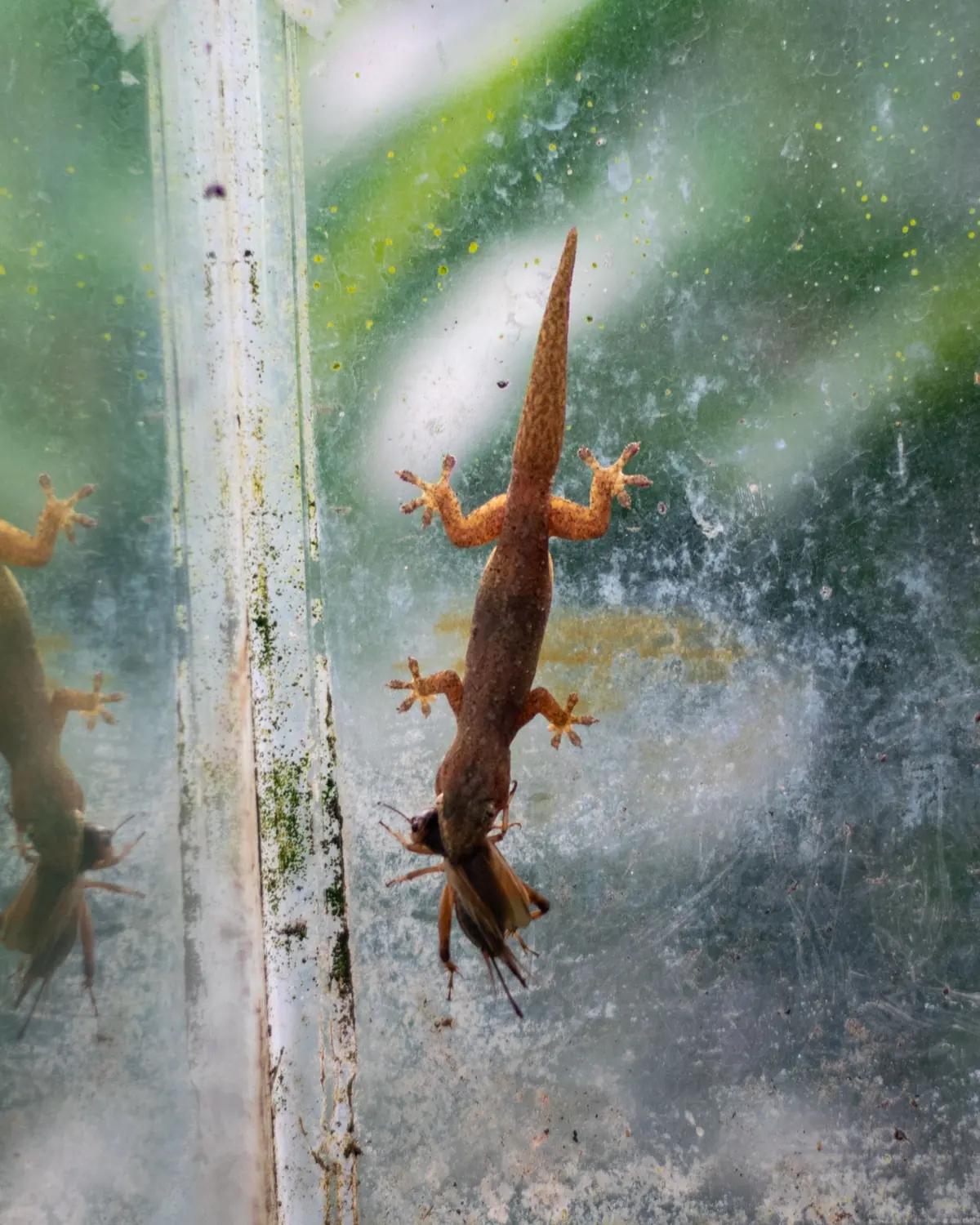
No home test can resolve nanoscale forces. Pulling a gecko from glass risks damaging toes, skin or joints. Adhesive tape, oils and cleaning chemicals can contaminate pads. Observation through a clean enclosure wall is enough; functional tests belong in approved specialist research.
What remains unresolved at the interface
Van der Waals attraction is the central dry-adhesion explanation for classic tokay-gecko setae, but real interfaces can include electrostatic charging, capillary forces, lipid traces and material deformation. Their contributions change with humidity and substrate. "It is van der Waals, full stop" should mean dominant evidence under defined conditions, not exclusion of every additional interaction.
Researchers still investigate how spatulae share load, how setal arrays avoid clumping, what sensory feedback controls engagement, and how wear is repaired through shedding. Scaling across species and body sizes remains active. Natural surfaces add dust, wax, moisture and roughness rarely combined in laboratory tests.
The open questions sit around a firm core: hierarchical structures create intimate contact; intermolecular attraction accumulates; directional loading engages it; peeling releases it. Uncertainty refines that chain rather than dissolving it.
The gecko controls proximity
The toe does not manufacture a powerful long-range force. Van der Waals attraction becomes useful only when surfaces approach extremely closely. The pad's achievement is to create that proximity across many small contacts despite roughness, then withdraw it in an ordered way.
Lamellae follow the wall. Setae bend and align. Branched endings multiply real contact. Shear recruits adhesion. Opposing limb forces stabilize the body. A peeling wave dismisses contacts from the edge. Stepping can shed some contamination before the next attachment.
That sequence explains both strength and speed without a magical material. It also explains the limits: water can occupy the interface, dust blocks contact, roughness defeats conformity, and the wrong loading angle releases the foot. A gecko walks on walls because its anatomy and movement continually negotiate distance at scales our eyes cannot see.
Frequently asked questions
Are gecko feet sticky like tape?
No wet glue is normally deposited. Hierarchical dry structures create close contact and direction-dependent intermolecular attraction.
Do geckos use suction cups?
No. Adhesion does not require sealed cavities or atmospheric pressure; isolated setae work without a suction chamber.
Is van der Waals force the whole story?
It is the dominant explanation for classic dry setal adhesion, while humidity, electrostatics, capillarity, lipids and deformation can contribute under some conditions.
Why can a gecko lift its foot so quickly?
It changes toe and seta angle and peels the pad from an edge, breaking contacts sequentially instead of all at once.
Can every gecko climb glass?
No. Toe-pad anatomy varies and some gecko species lack adhesive systems. Performance also depends on condition and surface.
Do gecko feet work when wet?
Not universally. Outcomes depend on species, whether the foot or substrate is wet, and surface chemistry; submerged adhesion can be greatly reduced.
How do gecko feet stay clean?
Repeated dry steps can transfer some particles to a cleaner surface, and grooming contributes. Sticky or oily contamination may persist.
Should I test my pet gecko's grip?
No. Do not pull, invert, contaminate or force an animal to climb. Observe voluntary movement and consult an exotic-animal veterinarian about toe problems.
Sources & further reading
This explainer was prepared through desk research using the sources below; established findings are distinguished from open questions in the text. See our editorial methodology.
- Autumn et al., Adhesive force of a single gecko foot-hair, Nature (2000) - single-seta force, preload/shear and directional behavior.
- Autumn et al., Evidence for van der Waals adhesion in gecko setae, Proceedings of the National Academy of Sciences (2002) - surface-chemistry tests supporting van der Waals dominance.
- Autumn & Peattie, Mechanisms of adhesion in geckos, Integrative and Comparative Biology (2002) - mechanism alternatives and hierarchical morphology review.
- Autumn et al., Dynamics of geckos running vertically, Journal of Experimental Biology (2006) - whole-body forces and locomotor context.
- Tian et al., Adhesion and friction in gecko toe attachment and detachment, Proceedings of the National Academy of Sciences (2006) - frictional adhesion, angle and peeling mechanics.
- Hansen & Autumn, Evidence for self-cleaning in gecko setae, Proceedings of the National Academy of Sciences (2005) - particle transfer and recovery over steps.
- Puthoff et al., Changes in materials properties explain the effects of humidity on gecko adhesion, Journal of Experimental Biology (2010) - humidity-dependent compliance and limits of a simple capillary explanation.
- Russell & Higham, A new angle on clinging in geckos: incline, not substrate, triggers the deployment of the adhesive system, Proceedings of the Royal Society B (2009) - digit deployment and functional-morphology context.
- Gamble et al., Repeated origin and loss of adhesive toepads in geckos, PLoS ONE (2012) - convergent evolution and non-universal pads.
- Stark et al., The effect of surface water and wetting on gecko adhesion, Journal of Experimental Biology (2012) - wet-substrate effects and conditional performance.
Spotted an error? We correct verified mistakes promptly — email contact@flashscience.org.
Continue exploring