Science explained · Life & Chemistry
Why Do Leaves Change Color in Fall?
When green disappears from a temperate deciduous canopy, which colors were uncovered, which were newly made, and what is the tree recovering before the leaf falls?
Explore the sections in this article
Green is expensive machinery
Chlorophyll absorbs strongly in blue and red regions of visible light and reflects or transmits more green, but it does not work alone. It is bound within protein complexes embedded in thylakoid membranes inside chloroplasts. Those photosystems capture energy, split water, move electrons and help produce the chemical currency used to fix carbon. Leaves continually synthesize and replace components damaged by light.
During the growing season, abundant chlorophyll visually masks other pigments. Carotenoids—yellow to orange molecules such as lutein and beta-carotene—are already present in chloroplasts. They broaden light capture and, crucially, help dissipate excess excitation that could damage the photosynthetic apparatus. Calling them “hidden paint” is a tolerable visual shorthand, but they are working molecules, not decorations waiting for October.
As senescence begins, the plant disassembles thylakoid membranes and chlorophyll-protein complexes. Chlorophyll must be detoxified as it is broken down because free intermediates can become photoreactive. A multi-step pathway converts green chlorophyll into colorless, less dangerous catabolites that are ultimately stored in the vacuole. The pathway was obscure for much of twentieth-century pigment research precisely because its final products are not brightly colored.
Day length is a calendar; weather edits the appointment
For many temperate woody species, shortening photoperiod supplies a reliable seasonal cue. Leaves and buds perceive the changing duration of light and darkness through regulatory networks involving photoreceptors, hormones and gene expression. The response depends on species and provenance: a northern population and southern population of the same species can differ because natural selection has tuned their timing to local growing seasons and frost risk.
Temperature modifies that program. Cool conditions can slow chlorophyll loss or favor sugar accumulation; hard freezing can damage tissues and truncate color. Drought may accelerate senescence or cause premature browning, yet responses vary with severity, timing and species. Nutrient status, disease, crown position and prior summer conditions also matter. No scientifically honest forecast follows from “warm days plus cold nights” alone.
This is why climate change cannot be translated into one universal promise of later or duller autumns. Warming can delay senescence in some places and species, while drought, altered frost timing, heat stress and changing growing-season productivity push in different directions. Experiments and long observational records often find temperature effects, but their size and even sign depend on cue interactions. A forest is a mixture of clocks.
The tree salvages before it sheds
Much of a leaf’s nitrogen resides in photosynthetic proteins, especially the abundant carbon-fixing enzyme Rubisco and associated machinery. During senescence, proteases and other systems dismantle cellular components. Transportable nitrogen compounds, phosphorus and some other nutrients move through the phloem into stems, roots or perennial tissues for storage and reuse. Recovery is substantial but never perfect; some nutrients leave with fallen litter and re-enter ecosystem cycles through decomposers.
Senescence is therefore not the same as instantaneous death. It is an active developmental phase requiring gene regulation and metabolic work. Cells remain functional long enough to dismantle selected structures, control reactive molecules and export resources. Eventually photosynthesis falls below its maintenance value, cellular integrity declines and the leaf is separated.
At the petiole base, an abscission zone develops. Specialized cell layers weaken their middle lamellae while the stem side forms a protective boundary. Wind or the leaf’s own weight can then finish the separation. The resulting scar limits water loss and pathogen entry. Different taxa form and activate this zone differently, and some dead leaves remain attached through winter—a condition called marcescence—so even “leaves fall when the tree seals them off” is not universal.
Yellow was present; many reds were made
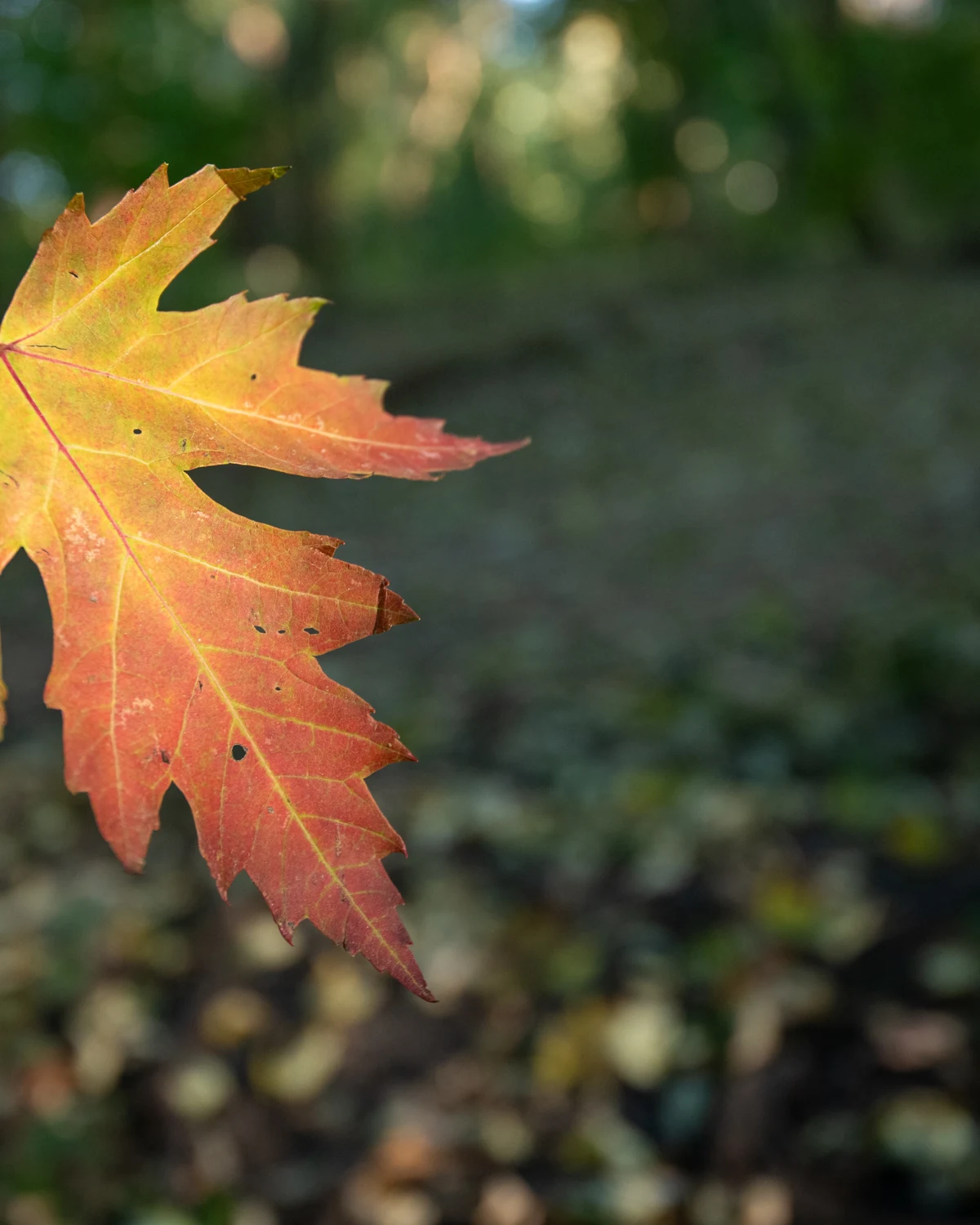
As chlorophyll abundance declines, carotenoids often persist longer and their yellow or orange contribution becomes apparent. Their visibility depends on concentration, leaf anatomy, chlorophyll remaining and illumination. The familiar phrase “yellow was there all along” is broadly useful for carotenoids, but not every autumn color can be explained by unmasking.
Red and purple anthocyanins are commonly synthesized during senescence in species and leaves capable of producing them. These water-soluble flavonoid pigments accumulate mainly in vacuoles rather than chloroplast membranes. Their hue changes with molecular structure, concentration, cellular pH and interactions with metals or other compounds. A red maple and a purple ornamental shrub need not contain the same pigment mixture or use the same timing.
Why spend carbon making pigment in a leaf scheduled for departure? Several hypotheses have evidence and continuing debate. Anthocyanins can screen light and reduce photo-oxidative stress when chlorophyll is being dismantled, potentially extending the interval for nutrient recovery. They are also antioxidants in some contexts. Other proposals include signaling to herbivorous insects or being consequences of carbon-nutrient balance. These explanations are not mutually exclusive, and evidence from one species or experiment should not be promoted into a universal evolutionary purpose.
Bright light and cool, nonfreezing conditions often correlate with redder displays in anthocyanin-producing leaves because light stress and retained sugars can favor synthesis. Yet “sugar trapped by cold makes red” compresses multiple regulatory steps. Sugar is both substrate and signal; temperature affects enzymes and transport; leaf position changes irradiance. Red is a biochemical response inside a particular living leaf.
Brown is a different ending
Brown leaves are often dominated not by one autumn pigment but by oxidized phenolics, tannins, dying tissue and the optical effects of collapsing cells. As membranes lose integrity, enzymes and substrates formerly kept apart can interact. Dry tissue scatters light differently. Disease, insect feeding, salt, heat or drought can create brown patches before normal senescence.
This distinction matters when reading a canopy. Yellow may indicate carotenoids revealed during orderly dismantling; red may indicate newly synthesized anthocyanins; brown may mark late tissue breakdown or injury. The colors can overlap. A single pixel in a satellite image cannot identify the pathway without supporting measurements.
A bounded measurement: color is not a pigment meter
Imagine a researcher measures light reflected from one leaf at two narrow bands. At 550 nanometres, near green, the green-stage leaf reflects 18% of incident light and the senescing leaf reflects 10%. At 650 nanometres, in red, the values are 6% and 20%. A simple red-to-green reflectance ratio changes from:
6 / 18 = 0.33 to 20 / 10 = 2.0.
The ratio increased sixfold. That makes a useful repeatable index for those leaves under a calibrated instrument, but it does not say that anthocyanin concentration increased sixfold. Reflectance also depends on chlorophyll loss, carotenoids, internal air spaces, surface wax, water, viewing angle and the lamp’s spectrum. A camera’s automatic white balance can shift it again.
Researchers therefore combine spectrometers or calibrated photographs with destructive pigment extraction, chromatography, chlorophyll fluorescence, gene-expression assays and repeated phenology observations. The numerical example is author arithmetic with hypothetical reflectances, not a diagnostic threshold or a forecast for a forest.
How scientists learned to separate disappearance from manufacture
Early chemists could extract green chlorophyll and yellow carotenoids, but extraction snapshots did not reveal the order of events inside an attached leaf. Chromatography later separated mixtures; spectroscopy identified absorption patterns; isotope tracing and molecular genetics followed atoms and enzymes through catabolic pathways. Mutant plants that stayed green proved especially revealing. Some “stay-green” mutants retain chlorophyll even as other senescence processes continue, showing that loss of green and loss of cellular function can be genetically uncoupled.
Field ecologists added another scale. They marked individual leaves, scored canopy color, measured litterfall and linked trees to weather records. Remote sensing now tracks spectral changes across landscapes, but satellites require ground validation because species composition, canopy shadows and understory can mimic timing shifts. Herbarium specimens and long-running citizen observations supply historical clues, though both have sampling biases.
The human thread runs from crushed pigment in a flask to genes switched on in a single cell and then outward to a forest viewed from orbit. Each scale answers a different question. Chemistry tells what absorbs light. Physiology tells when the plant dismantles. Ecology tells what timing costs or saves. None by itself explains the entire hillside.
Autumn is an economic decision under risk
A leaf gains carbon only while incoming light, temperature, water supply and biochemical capacity make photosynthesis worth its costs. Keeping it exposes the tree to frost, wind, snow loading, herbivores and continuing respiration. Dropping it forfeits possible warm days but protects water-conducting tissues and allows nutrient storage. Evolution tunes this tradeoff through developmental thresholds rather than conscious calculation.
The balance differs for evergreens. Many needles and tough broad leaves defend their tissues and retain them across unfavorable seasons, spreading construction cost over several years. They still senesce and shed, just not as one synchronized autumn curtain. Drought-deciduous plants may abandon leaves during dry periods. Some tropical species flush and shed on schedules that do not resemble a northern calendar.
Thus “trees lose leaves to survive winter” is locally useful but globally incomplete. Leaves are replaceable organs, and their useful lifespan reflects climate, construction cost, nutrient availability, herbivory and lineage.
What remains uncertain
Researchers can identify major chlorophyll-catabolic enzymes and monitor many senescence genes, yet predicting one tree’s peak color weeks ahead remains difficult. Weather acts on a system already shaped by genotype, leaf age and accumulated stress. Anthocyanin function remains plural: photoprotection has strong experimental support in several systems, but its ecological benefit and evolutionary history vary.
Even the visual endpoint is observer-dependent. Human color categories compress continuous spectra. A leaf may lose chlorophyll before a viewer calls it yellow; red anthocyanin can mask remaining green; structural change can brighten or dull both. Climate projections add uncertainty from future drought, frost, species turnover and acclimation. It is safer to project mechanisms and ranges than a single universal color trend.
The central mechanism, however, is secure. In a typical temperate deciduous leaf, seasonal cues initiate regulated senescence. Photosynthetic machinery is dismantled, chlorophyll is converted to non-green products, recoverable nutrients are exported, carotenoids become more visible, and some species synthesize anthocyanins. Abscission eventually releases the organ.
One tree can run many autumns at once
Canopy position turns a single tree into a useful natural experiment. Outer leaves receive stronger sunlight, greater wind exposure and often larger temperature swings than inner leaves. A south-facing crown in the Northern Hemisphere may accumulate a different light and heat history from its shaded north side. Shoots formed at different times carry leaves of different developmental ages. The tree distributes water and nutrients unevenly through a branching hydraulic network. Consequently, genetically identical leaves need not cross the senescence threshold together.
Researchers can exploit that variation, but only with careful sampling. Comparing a red sun leaf with a green shade leaf confounds pigment state with anatomy: sun leaves are often thicker and may contain different chloroplast densities. A rigorous design repeatedly measures tagged leaves, records their crown positions and samples comparable tissue areas. It may pair spectral reflectance with extracted pigment per fresh mass, dry mass or area. Each denominator answers a different question because a drying leaf loses water while its surface and mass change.
The tree’s own source-sink economy also shifts. Early in a season, an expanding leaf imports carbon; once mature, it exports sugars. During senescence, export continues while photosynthetic supply declines. Nearby fruits, roots, buds and woody storage tissues compete as sinks. A shaded leaf may be retired early because its carbon return is low, while a well-lit leaf persists—unless excess light makes dismantling machinery dangerous. This local accounting helps explain mottled crowns without imagining that one side received “more autumn.”
Color tourism turns these biological transitions into a cultural calendar, and that creates unusually large observational archives. Repeated photographs and volunteer phenology records can extend monitoring beyond research plots. They remain valuable only when analysts account for camera processing, changing vantage points, species identification and the tendency to record spectacular years. A phone image can document date and place; it cannot replace pigment chemistry.
Color continues after separation
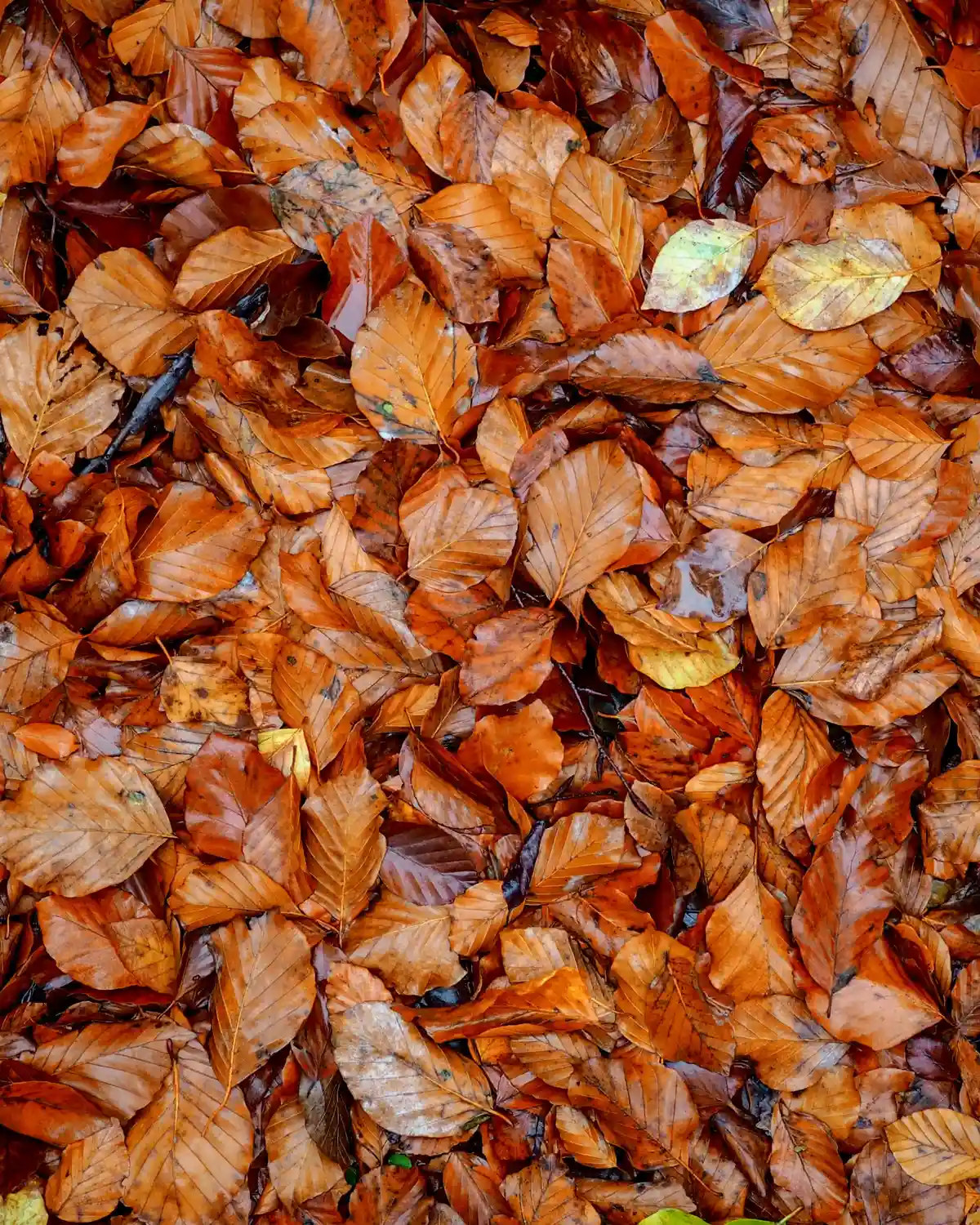
Once a leaf detaches, its chemistry and optics keep changing. Water evaporates, cells collapse and microbial colonists grow. Rain leaches soluble compounds. Sunlight photodegrades pigments. Tannins and lignified structures persist longer than many cellular components, contributing to the durable brown of litter. The forest floor therefore contains a second sequence distinct from senescence on the branch.
Decomposition returns carbon dioxide to the atmosphere and moves organic matter into soil food webs; some carbon becomes longer-lived soil material. Nitrogen immobilization and release depend on litter chemistry and decomposer communities. A red leaf is not “better fertilizer” merely because it contains anthocyanin, and bright canopy color does not directly predict decomposition rate. Species with tough, nutrient-poor leaves can retain litter longer than species with soft, nutrient-rich leaves.
This afterlife completes the budget. The tree recovers selected resources, the abscission zone releases the organ, and the ecosystem processes what remains. Autumn color occupies only the brief interval when cellular dismantling is far enough along to alter reflected light but organized tissue is still visible.
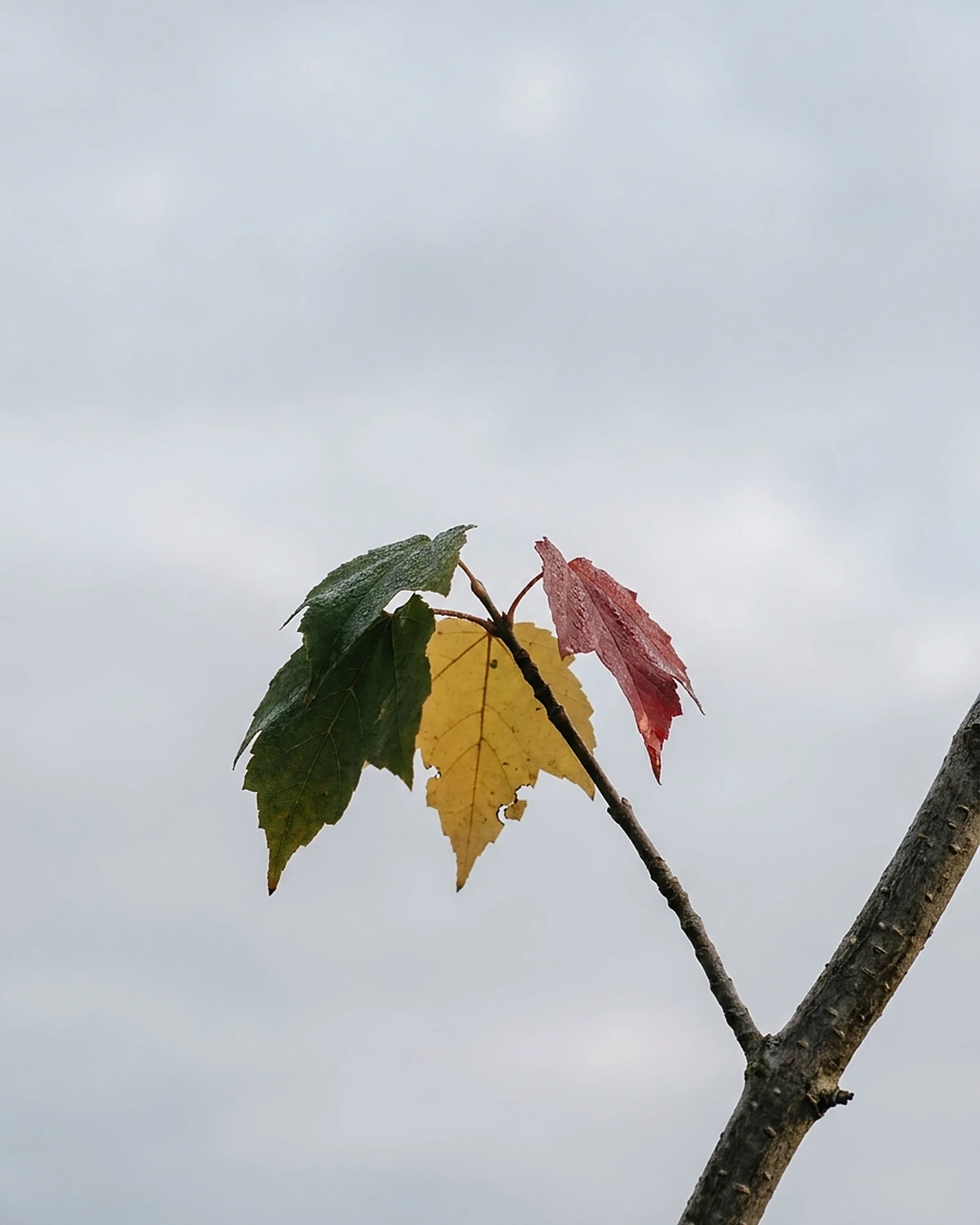
Return to that mixed branch and its unevenness now makes sense. The shaded leaf received a different light dose. The red margin may be synthesizing anthocyanin while chlorophyll persists elsewhere. The brown patch may record damage rather than the calendar. Autumn is not paint applied to a passive surface. It is the visible account of a plant deciding, cell by cell, what to save before letting go.
Frequently asked questions
Does cold make leaves change color?
Cold can modify timing and pigment production, but shortening day length is a major cue in many temperate woody plants. Species, drought, light, nutrients and frost all alter the result.
Were yellow pigments already in the leaf?
Often yes. Chloroplast carotenoids function during the green season and become conspicuous as chlorophyll declines.
Were red pigments already there too?
In many red-coloring deciduous species, anthocyanins are synthesized during senescence. The answer is species- and tissue-specific.
Why do some trees turn red and others yellow?
They differ genetically in pigment pathways, anatomy and regulation. Environment changes expression but cannot give every lineage the same biochemical capacity.
Does a brilliant autumn predict a cold winter?
No established mechanism turns leaf color into a reliable seasonal forecast. The display mostly records conditions before and during senescence.
Does climate warming always delay leaf fall?
No. Warming can delay senescence in some systems, while drought, heat, frost changes and species turnover can counteract it.
Are fallen leaves dead waste?
They are largely dead tissue, but not ecological waste. Decomposers return carbon and nutrients to soils and food webs after the tree has recovered only part of its investment.
Should I remove every fallen leaf?
Management depends on safety, turf, fire and disease context. Where appropriate, leaving or mulching some litter can retain habitat and nutrients; consult local guidance for diseased material.
Sources & further reading
This explainer was prepared through desk research using the sources below; established findings are distinguished from open questions in the text. See our editorial methodology.
- Lim, Kim & Nam, Leaf senescence, Annual Review of Plant Biology (2007) — regulated senescence, nutrient remobilization and gene control.
- Hörtensteiner & Kräutler, Chlorophyll breakdown in higher plants, Biochimica et Biophysica Acta (2011) — chlorophyll-catabolic pathway and non-green products.
- Keskitalo et al., A cellular timetable of autumn senescence, Plant Physiology (2005) — field sequence in aspen leaves.
- Matile, Hörtensteiner & Thomas, Chlorophyll degradation, Annual Review of Plant Physiology and Plant Molecular Biology (1999) — biochemical history and pathway framing.
- Archetti et al., Unravelling the evolution of autumn colours, Trends in Ecology & Evolution (2009) — competing hypotheses and cross-species caution.
- Gould et al., Why leaves are sometimes red, Nature (1995) — experimental photoprotection proposal.
- Lee, O’Keefe, Holbrook & Feild, Pigment dynamics and autumn leaf senescence in a New England deciduous forest, Ecological Research (2003) — field pigment trajectories and species variation.
- Estiarte & Peñuelas, Alteration of the phenology of leaf senescence and fall in winter deciduous species by climate change, Global Change Biology (2015) — interacting climate controls and uncertainty.
- U.S. Forest Service, Science of Fall Colors — public institutional synthesis on chlorophyll, carotenoids, anthocyanins and weather.
Spotted an error? We correct verified mistakes promptly — email contact@flashscience.org.
Continue exploring